


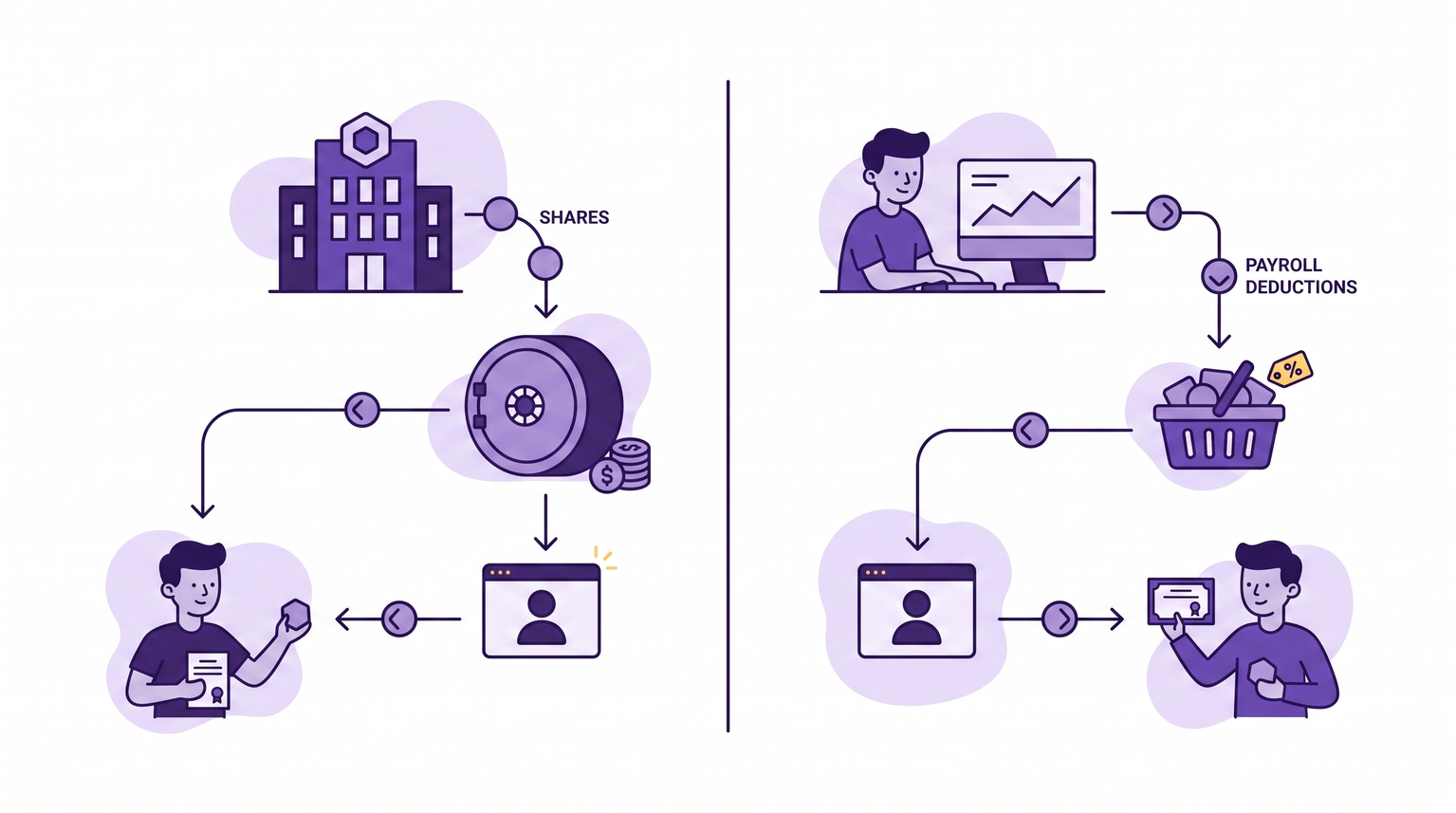


This article will review the Best Equity Compensation Platforms for Startups in 2026. With equity compensation becoming essential for talent retention and recruitment, startups rely on compliance, transparency, and scalability in equity compensation platforms.
This report analyzes the best available and affordable platforms (Pulley and Cake Equity) as well as the most advanced enterprise platforms (Shareworks and JP Morgan Workplace Solutions) for founders globally.
How To Choose Equity Compensation Platforms for Startups
Compliance Support
Does the platform support 409A valuations, ASC 718 reporting, and jurisdictional compliance (e.g. India’s Companies Act, EU regulations)?
Pricing Transparency
Compare annual costs. More affordable options perhaps include Pulley and Cake Equity, vs Shareworks and JP Morgan Workplace Solutions.
Scalability
Choose platforms that scale with your startup. Carta and Ledgy are good for global scaling. Pulley is good for seed stage.
Employee Engagement
Platforms like Cake Equity and Ledgy have dashboards that show employees their vesting and ownership, increasing transparency.
Integration
Check for HR, payroll, and banking integrations. For equity and banking, AngelList Stack has both. Qapita integrates with HR systems.
Key Points
| Platform | Best For | Key Features |
|---|---|---|
| Carta | Global startups | Cap table accuracy, 409A valuations, option grants, fund admin |
| Pulley | Budget-conscious early-stage firms | Affordable ($1,200/yr), YC-backed, fast onboarding |
| Cake Equity | Founder-friendly startups | Automated cap tables, ESOP workflows, transparent pricing |
| Eqvista | SMEs & scaling firms | Digital grant issuance, valuations, shareholder reporting |
| Qapita | Indian & Asian startups | ESOP lifecycle automation, board approvals, compliance |
| Ledgy | European scale-ups | ESOP automation, EU compliance, employee dashboards |
| AngelList Stack | Startups bundling equity + banking | Integrated equity, fund admin, banking |
| Shareworks | Late-stage/pre-IPO firms | Enterprise-grade compliance, ASC 718 reporting |
| Fidelity Private Shares | Private market equity | Equity plan administration, audit-ready workflows |
| JP Morgan Workplace Solutions | Multinational teams | Equity compensation, plan administration, compliance reporting |
1. Carta
Carta’s equity management platform may be the most well-known to start-ups and early-stage companies that have received venture funding. This platform has a wide range of services which include administering funds, managing cap tables, and doing valuations.
Pricing for this service is approximately $2,800 per year for early-stage start-ups. Carta’s service offers assistance with compliance, reporting that is audit-ready, and is effective in communicating with potential investors.
Mid-way down their services, Carta offers back-office support for venture funds, providing a one-stop-service for founders and investors. With services that span across borders and integrations for payroll and HR systems, Carta’s platform is optimal for founders that are preparing their companies for an IPO.
Carta Characteristics
- Precise cap table management in real time
- 409A valuations and compliance support
- Employee equity dashboards and option grants
- Investor fund administration
- IPOs and secondary transactions
| Advantages | Disadvantages |
|---|---|
| Trusted by global startups | Higher pricing than competitors |
| Strong compliance & 409A valuations | Complex for very early-stage firms |
| Investor communication tools | Extra fees for advanced modules |
| IPO readiness support | Limited flexibility for small teams |
| Fund administration included | Can feel enterprise-heavy |
| Seamless HR/payroll integrations | May require onboarding support |
| Widely recognized brand | Not ideal for budget-conscious founders |
2. Pulley
Founded in 2019, Pulley also provides an equity management service for early-stage ventures and is a service offered through Y Combinator. Their pricing is set at $1,200 per year which is one of the most economical options for early-stage start-ups.
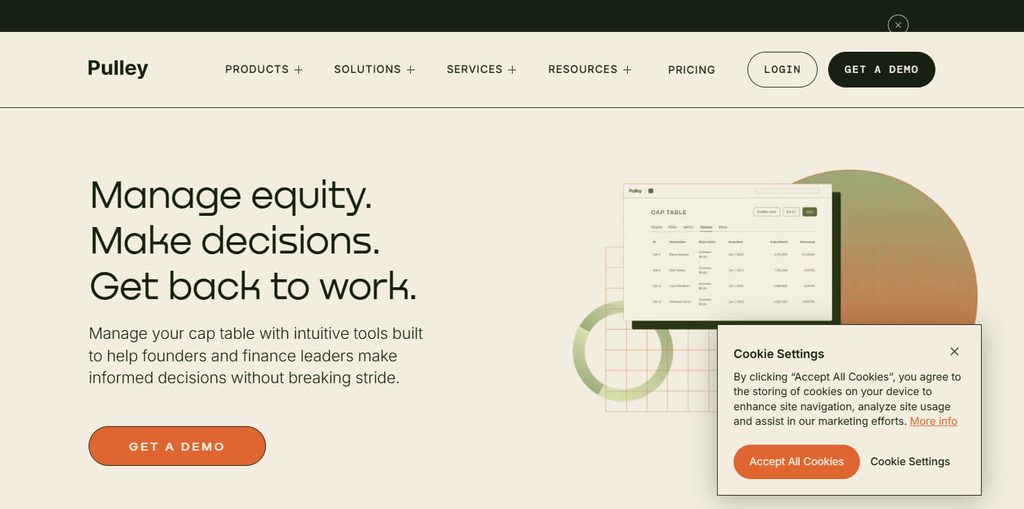
Pulley offers an automated cap table, the issuance of stock options, and a modeling tool for the potential of upcoming fundraises. Speed and ease of use are the priorities of their service offering.
Founders can quickly onboard users without complicated compliance issues. This service is used by seed-stage companies for clarity over ownership at a cost below Carta’s services. Their service is affordable and easier to use and because of this, many early-stage start-ups use this service.
Pulley Characteristics
- Early stage startup-friendly pricing
- Automated cap table and share issuance
- Fundraising round scenario modeling
- Rapid onboarding, backed by YC
- Simple UI
| Advantages | Disadvantages |
|---|---|
| Affordable pricing ($1,200/yr) | Limited enterprise features |
| YC-backed credibility | Less global compliance depth |
| Fast onboarding | Smaller support ecosystem |
| Simple founder-first interface | Fewer advanced reporting tools |
| Scenario modeling for fundraising | Not ideal for IPO-stage firms |
| Transparent pricing | Limited integrations |
| Great for seed-stage startups | Regional coverage weaker than Carta |
3. Cake Equity
Founded in 2018 in Australia, Cake Equity aims to simplify equity management for founders and employees.
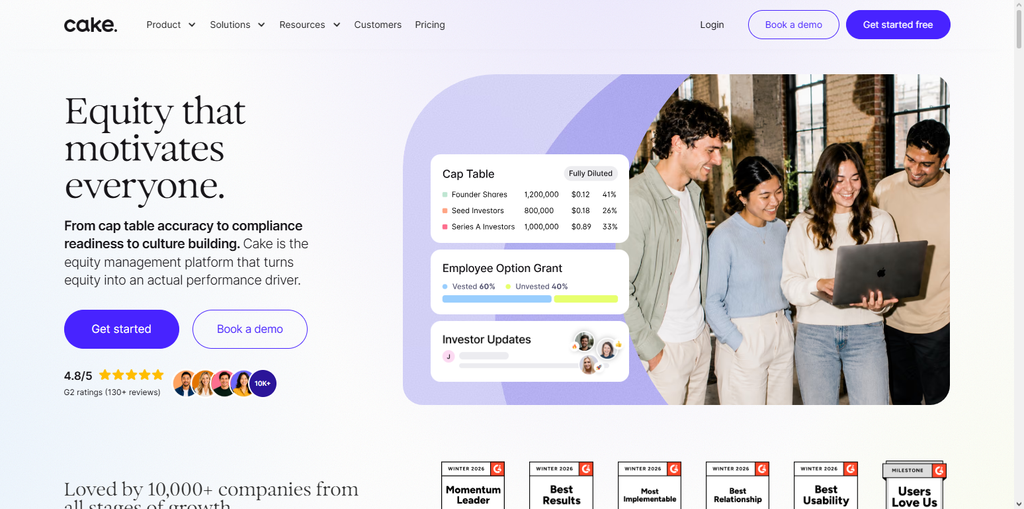
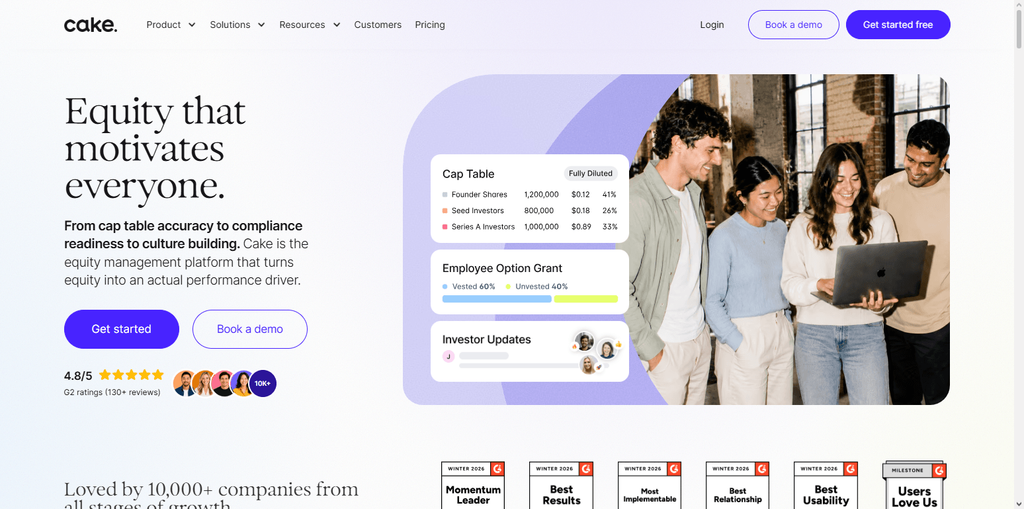
Priced from $1,000 per year, Cake Equity offers transparent pricing catered to larger teams. Cake Equity’s automation aims to simplify the management of cap tables and ESOP workflows. The middle of the offerings focuses on employee transparency dashboards allowing employees to track vesting and ownership.
Cake is a distributed equity management solution for simplified compliant equity distribution. Cake equity is strong in Australia, the UK, and the larger Asia-Pacific region, due to its cross-border compliance and employee engagement solutions.
Cake Equity Characteristics
- Pricing with plans that scale
- Workflows and automation for ESOPs
- Compliance and cap table management
- Employee visibility dashboards for equity
- Equity support in APAC
| Advantages | Disadvantages |
|---|---|
| Transparent, low-cost pricing | Less known outside APAC |
| Automated ESOP workflows | Limited enterprise compliance |
| Employee dashboards for clarity | Smaller valuation support |
| Strong in Australia & UK | Not as scalable as Carta |
| Cross-border equity support | Fewer integrations |
| Easy-to-use for founders | Limited investor tools |
| Focus on employee engagement | Regional dominance only in APAC |
4. Eqvista
Launched in 2018, Eqvista helps SMEs and startups scale with digital equity management platforms, and pricing starts from $1,000 per year, with other more customized tiers available.
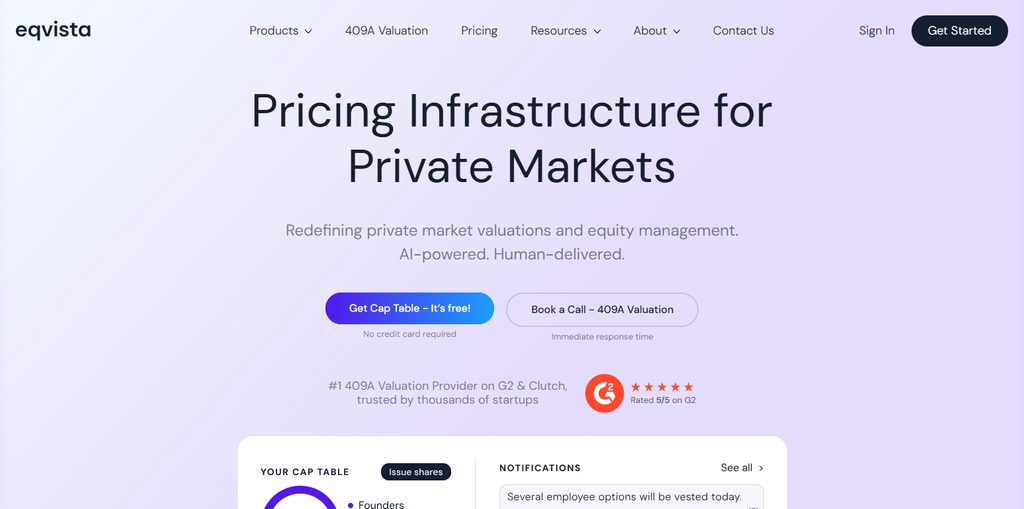
Services include cap table management, digital grants, valuations, and shareholder reporting. In the middle ranges of its services, Eqvista provides startup valuation support and compliance with tax and audit requirements.
Its solutions allow founding teams to digitize share issuance and maintain control and transparency of investments. Eqvista is particularly well-suited for startups that need affordable valuation services and equity management, as it competes well with Pulley and Cake Equity.
Eqvista Characteristics
- Digital share and option issuance
- Affordable 409A valuation services
- SME cap table automation
- Shareholder reporting and investor transparency
- Simple platform built for scaling firms
| Advantages | Disadvantages |
|---|---|
| Affordable valuation services | Smaller global footprint |
| Digital issuance of shares | Limited enterprise features |
| Cap table automation | Not IPO-focused |
| Shareholder reporting | Fewer integrations |
| Easy-to-use platform | Less brand recognition |
| Strong for SMEs | Limited advanced compliance |
| Transparent pricing | Smaller support network |
5. Qapita
Qapita was started in 2019 and focuses on Indian and Asian startups. Prices start at around $1,500 per year, with plans for larger companies. Qapita helps with the automation of ESOPs, workflow for board approvals, and compliance with the Indian Companies Act.
In the middle of its services, Qapita helps startups in Asia comply with regional regulations while helping businesses manage their equity compliance without the risk of legal issues. It also integrates with HR systems to automate communication to employees.
Qapita is especially helpful for startups that operate in India, Singapore, and Indonesia because compliance is very important in these local markets. Because of its focus on ESOP transparency, it is an excellent and trusted partner for founders and employees.
Qapita Characteristics
- Automation of the ESOP lifecycle
- Compliance with the Companies Act in India
- Workflows in conjunction with board approvals
- Integration with the company’s HR system for communicating equity
- Strong presence in India and Southeast Asia
| Advantages | Disadvantages |
|---|---|
| Tailored for Indian startups | Regional focus limits global reach |
| ESOP lifecycle automation | Pricing higher than Pulley |
| Compliance with Companies Act | Less suited for U.S. firms |
| Board approval workflows | Limited investor tools |
| HR system integration | Smaller brand recognition |
| Strong in Asia | Not IPO-focused |
| Transparent employee communication | Limited enterprise features |
6.Ledgy
Ledgy, founded in 2017 in Switzerland, is the biggest equity management platform in Europe. Pricing for Ledgy starts at €1,500 annually for services that include automation of cap tables, compliance with EU regulations, and management of employee stock ownership plans (ESOPs).
Ledgy‘s employee dashboards are the focal point of the service. Employees are able to view their equity stake in the company, and track their ownership and vested equity. Ledgy is particularly well suited to European scale-ups that are looking to prepare for IPOs and cross-border capital raises.
It integrates easily with payroll and HR systems, ensuring seamless operation across bridged teams. Its compliance focused approach is popular among startups that are focused in Europe.
Ledgy Characteristics
- Automation of cap tables for European startups
- ESOP compliance in the EU
- Employee dashboards for tracking ownership
- Support for cross border
- Integration for payroll and HR
| Advantages | Disadvantages |
|---|---|
| EU compliance strength | Pricing higher than Cake |
| Employee dashboards | Limited outside Europe |
| Cap table automation | Smaller valuation services |
| Cross-border fundraising support | Less suited for U.S. startups |
| Payroll/HR integrations | Not IPO-focused |
| Strong for European scale-ups | Limited investor tools |
| Easy-to-use interface | Regional dominance only in EU |
7. AngelList Stack
Launched in 2021, AngelList Stack has products for equity management, startup banking and fundraising combined into one service. Pricing is simple and starts from $1,000 per year. Bundled services include incorporation, banking, and equity.
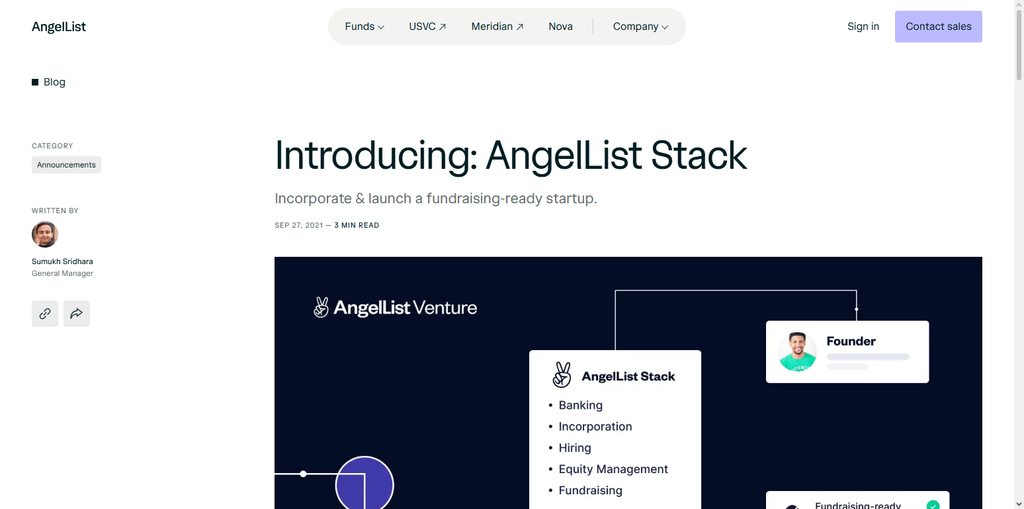
AngelList Stack provides cap table management, option grants, and many other tools for investor communications. When it comes to managing startup equity, Stack places a strong focus on the integration of its services allowing founders to manage equity together with banking and fundraising.
Stack is geared toward U.S. startups who want one service rather than many. AngelList’s VC experience has helped appropriately position Stack as a simplified service and trusted among founders.
AngelList Stack Characteristics
- Bundled equity, incorporation, and banking services
- Cap table management with outgoing investor communications
- Employee option granting
- Workflows integrated for fundraising
- Relied on by U.S. venture-backed startups
| Advantages | Disadvantages |
|---|---|
| Bundled equity + banking | Limited outside U.S. |
| Trusted AngelList brand | Not enterprise-focused |
| Cap table management | Smaller compliance depth |
| Option grant issuance | Limited advanced reporting |
| Integrated fundraising workflows | Less suited for IPO prep |
| Affordable pricing | Regional coverage weaker |
| One-stop startup solution | Limited HR/payroll integrations |
8. Shareworks
Shareworks, a Morgan Stanley subsidiary, was founded in 1999 as an enterprise-level equity compensation system. Though it costs at least $5,000 a year to use, it is primarily aimed toward businesses that are either in a late-stage funding round or getting ready to go public for the first time.

In the center of its services, Shareworks focuses on enterprise compliance making it a good choice for companies in the run-up to an IPO or for businesses with teams distributed across many countries.
Shareworks is a leader in corporate equity management due to its robust reporting and integration with financial systems. Shareworks meets the needs of larger companies which require a high level of compliance and audit support.
Shareworks Characteristics
- Automates ASC 718 reporting
- Administers international equity awards
- Streamlines audit-ready workflows
- Helps prepare for IPOs and provides multi-country support
- Integrates with financial systems
| Advantages | Disadvantages |
|---|---|
| Enterprise-grade compliance | High pricing ($5,000+) |
| ASC 718 reporting | Complex onboarding |
| Global equity plan administration | Not ideal for small startups |
| Audit-ready workflows | Heavy enterprise focus |
| IPO preparation support | Limited affordability |
| Integration with financial systems | Smaller founder-first features |
| Trusted by large firms | Less flexible for SMEs |
9. Fidelity Private Shares
Fidelity Private Shares was founded in 2021 as Fidelity’s offering for private market equity management. Services are enterprise focused, starting at $3,000 annually, and provide equity plan administration, audit-ready workflows, and compliance reporting.
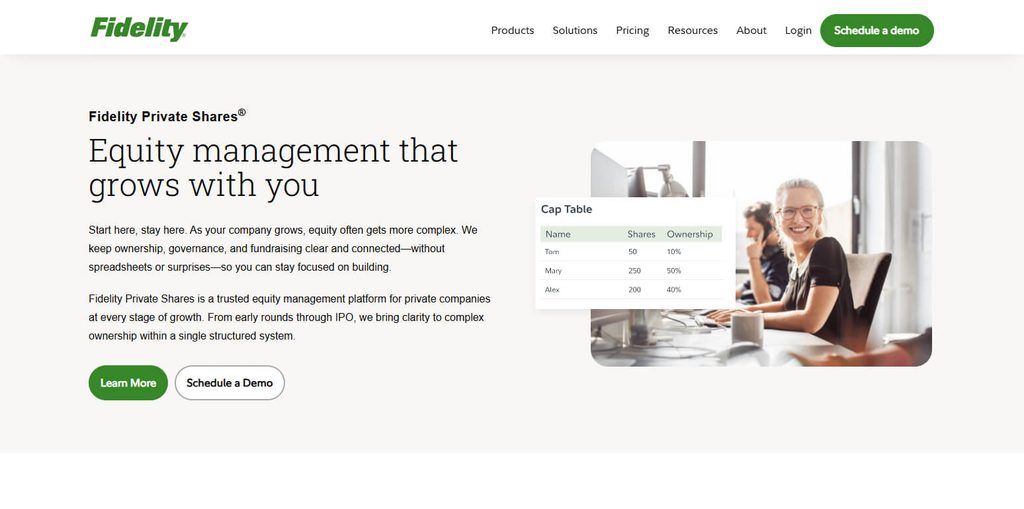
In the middle of its services, Fidelity focuses on private market support and helps start-ups set up equity before an IPO or an acquisition. Its integration with Fidelity’s financial services makes it strong as a financial partner.
Fidelity Private Shares is strongest for start-ups that want the highest level of reporting and compliance without flexibility.
Fidelity Private Shares Characteristics
- Administers private company equity plans
- Generates audit-ready compliance reports
- Integrates with Fidelity’s financial services
- Support for pre-IPO activities and transactions
- Institutional-grade security and trust
| Advantages | Disadvantages |
|---|---|
| Institutional-grade trust | Higher pricing ($3,000+) |
| Audit-ready compliance | Less suited for early-stage |
| Equity plan administration | Limited global coverage |
| Pre-IPO readiness | Smaller founder-first tools |
| Integration with Fidelity services | Enterprise-heavy |
| Strong private market support | Fewer employee dashboards |
| Secure & reliable | Limited startup focus |
10. JP Morgan Workplace Solutions
JP Morgan Workplace Solutions launched in 2020 and caters to multinational teams managing equity compensation. It offers enterprise-level pricing starting at $4,000 for administering equity plans and preparing compliance reports.

It also supports the communication of equity plans to employees. JP Morgan adds an emphasis to global compliance so that companies can manage equity in multiple geographical locations.
JP Morgan’s Workplace Solutions also integrates JP Morgan’s financial services making it an excellent choice for large, rapidly growing organizations. Workplace Solutions has built trust among organizations that mean compliance and employee engagement. This makes it a premium choice offered by global startups and enterprises.
JP Morgan Workplace Solutions Characteristics
- Administers international equity compensation
- Reporting requirements compliance for all countries
- Employee-facing dashboards
- Integrates JP Morgan’s financial services
- Enterprise support for multi-country teams
| Advantages | Disadvantages |
|---|---|
| Global compliance strength | Higher pricing ($4,000+) |
| Employee communication dashboards | Complex onboarding |
| Integration with JP Morgan services | Enterprise-heavy |
| Equity plan administration | Not ideal for seed-stage |
| Multinational team support | Limited affordability |
| Trusted financial brand | Smaller startup ecosystem |
| Strong compliance reporting | Less flexible for SMEs |
Conclusion
In 2026 there will be a multitude of mature equity compensation software choices based on the stage of a startup, region, and budget. When considering compliance and investor relations across all jurisdictions, Carta remains the clear choice.
Earlier stage company founders will appreciate the affordable products offered by Pulley and Cake Equity. Eqvista is an excellent choice for founders looking for equity valuation support and digital issuance. For founders in Asia, Qapita is the clear choice.
If founders are located in Europe, then they should consider Ledgy. AngelList Stack makes the administration of equity much easier. Enterprise level products from Shareworks, Fidelity Private Shares, and JP Morgan Workplace Solutions take care of the compliance for larger multi-national companies.
The right choice will be a function of the startup’s stage and geography, and all ten of the platforms provide excellent compliance.
FAQ
What is equity compensation?
Equity compensation refers to non-cash pay offered to employees, such as stock options, restricted stock units (RSUs), or employee stock ownership plans (ESOPs). It aligns employee incentives with company growth.
Which platform is best for early-stage startups?
For seed-stage firms, Pulley and Cake Equity are ideal due to affordable pricing and simple onboarding.
Which platform is best for global compliance?
Carta, Shareworks, and JP Morgan Workplace Solutions are trusted for audit-ready workflows and multinational compliance.
Which platform is strongest in Asia?
Qapita dominates in India and Southeast Asia, offering ESOP lifecycle automation and compliance with regional laws.