



Your choice of partner can either elevate or destroy a business valuation. This article will address the best firms that conduct valuations on private businesses. I will analyze each firm’s industry knowledge, available services, and associated best practices. Whether you require a valuation for M&A, tax, litigation, or general planning, this article will help you pinpoint the firm that meets your firm’s needs best.
What Is a Private Company Valuation Firms?
A private company valuation firm is a service that specializes in evaluating the fair market value of non-publicly traded companies. Valuing private firms is more challenging than valuing publicly traded firms, since the latter have stock market prices. Specialized methods, such as discounted cash flow analysis, market comparable analysis, and asset-based valuation, are used to value private firms.
Firms hire private company valuation firms for a myriad of reasons, including mergers and acquisitions, tax reporting, litigation support, estate planning, and capital raising. A valuation report is only as good as the valuation professional’s financial modeling skills, business know-how, and understanding of regulatory frameworks. Private firms rely on valuation firms during sale transactions, investment transactions, disputes, and financial reportings.
Why Private Companies Need Valuation in 2026
Mergers & Acquisitions Activity: Private companies in the ever-competitive M&A market need valuations to pursue deals, whether as a buyer, seller, or merging party, to help navigate the deal.
Attracting Investors & Raising Capital: Private Equity and VC funds rely on accurate valuations to determine an equity stake, set terms, and account for ownership dilution.
Tax Compliance & Estate Planning: Ownership valuations have an impact on gift and estate tax compliance and may potentially save a company from costly IRS audits.
Financial Reporting Requirements: Any business with outside investments or debt agreements that have imposed covenants often requires a timely valuation to remain compliant with the reporting standards on Goodwill Impairment.
Employee Stock Ownership Plans (ESOPs): Businesses that offer equity as part of their employee benefits need timely valuations to set fair compensation for their equity benefits.
Litigation & Dispute Resolution: Valuations performed by industry experts provide significant assistance in shareholder disputes and other cases that require expert testimony.
Succession Planning: The valuation of a business is essential for a business owner to know the best approach for managing the transfer of ownership to the next generation or to conduct a partial sale.
Economic Uncertainty & Market Volatility: Valuations provide the business owner with knowledge and the opportunity to plan for an uncertain future as the economy fluctuates.
Regulatory & Compliance Changes: Private businesses must be prepared for new regulations, as business valuations support strategic business decisions.
Strategic Decision-Making: Business Valuations enable business owners to decide how they want to proceed with the business based on the true worth of their business.
Key Points
| Firm | Strengths | Best Use Cases |
|---|---|---|
| PwC Valuations | Global leader, audit-aligned, strong governance | Complex M&A, impairment testing, purchase price allocation |
| EY Valuation & Strategy | Deep industry coverage, strong modeling rigor | Fundraising, IPO prep, strategic planning |
| KPMG Valuation Services | Audit-defensible, IFRS/Ind-AS expertise | Public-company reporting, cross-border deals |
| Deloitte Valuation | Broad coverage, tech-enabled valuation tools | Private equity, restructuring, ESOP valuations |
| Grant Thornton | Mid-market strength, regulatory compliance | SME valuations, insolvency proceedings |
| Biz Valuations | India’s #1 valuation firm, IBBI registered | FEMA/FDI compliance, startup fundraising, ESOPs |
| Transaction Capital LLC | Strong in emerging markets | Cross-border private company valuations |
| Charles River Associates | Litigation & arbitration focus | Disputes, fairness opinions, evidence-ready reports |
| Houlihan Lokey Valuation | Leading independent advisory | Private equity portfolio valuations, fairness opinions |
| Duff & Phelps (Kroll) | Global valuation powerhouse | ESOPs, 409A, tax compliance, complex corporate valuations |
1. PwC Valuations
PricewaterhouseCoopers (PwC) was formed in 1998, with its roots going back to the mergers of Price Waterhouse and Coopers & Lybrand in 1998, along with earlier firms tracing back as far as 1849. Its valuation unit helps its clients with the reporting of financial impacts, assessments of purchase price allocations, goodwill, and impairment tests, along with tax valuations and complex securities pricing.

PwC serves multinational, private equity and family businesses in virtually all industry segments. Clients appreciate the EY Valuations deep regulatory know-how and strong global infrastructure in over 150 countries, so they select them for high-quality valuation work that is audit defensible and supported by deep research.
Industry Knowledge: Financial services, technology, healthcare, and consumer markets.
Client Size: Large enterprises, multinational corporations, and mature private companies
Coverage: 150+ countries and strong cross border integration. Global.
Situations: Financial reporting valuations, purchase price allocations, and multinational tax compliance
Advantage: Expertise in regulation and documentation that is audit defensive.
Possible Concern: Expensive and lengthy time-lines for smaller or simpler engagements.
PwC Valuations Features
| Feature | Details |
|---|---|
| Founded | 1998 (modern merger); roots to 1849 |
| Headquarters | London, UK |
| Core Services | Financial reporting valuations, PPA, goodwill impairment, tax valuations |
| Industry Focus | Financial services, technology, healthcare, consumer markets |
| Client Size | Large enterprises, multinational corporations |
| Global Presence | 150+ countries |
| Technology | Proprietary valuation software and data analytics tools |
| Regulatory Expertise | Strong compliance with IFRS, GAAP, and cross-border tax laws |
| Pricing Tier | Premium/high-cost |
| Turnaround Time | Moderate to slow for complex, multi-entity valuations |
2. EY Valuation & Strategy
EY was founded in 1989 when Ernst & Young united with Arthur Young. Both of those firms have lineages that go back to the late 1800s. EY’s VME (Valuation, Modeling, & Economics) Practice provides valuation, modeling, transaction advisory, and restructuring valuations combined with litigation support services.

They specialize in providing valuations to private equity, corporate, and legal clients involved in mergers and acquisitions transactions and disputes. EY has strong Integration of valuation with other strategic services and advisory, thus assisting its clients in the assessment of the financial impacts of their business strategies.
Industry Knowledge: Technology, energy, financial services, and private equity backed businesses.
Client Size: Mid to large corporations / PE/VC portfolio companies.
Coverage: Significant coverage in N. America, Europe, and Asia
Situations: M&A support, financial modeling, valuations, and strategic integration.
Advantage: A strong combination of valuation and advisory experience.
Potential Concern: Relatively expensive for small businesses or singular valuations.
EY Valuation & Strategy Features
| Feature | Details |
|---|---|
| Founded | 1989 (merger); predecessor firms from 1849 |
| Headquarters | London, UK |
| Core Services | Valuation, financial modeling, transaction advisory, restructuring valuations |
| Industry Focus | Technology, energy, financial services, private equity |
| Client Size | Mid-to-large corporations, PE/VC portfolio companies |
| Global Presence | 150+ countries |
| Technology | Advanced financial modeling and economic analysis tools |
| Regulatory Expertise | Strong in M&A compliance and strategic valuation integration |
| Pricing Tier | Premium/high-cost |
| Turnaround Time | Moderate, faster for transaction-focused engagements |
3. KPMG Valuation
KPMG was founded in 1870 and is one of the oldest accounting firms. It adopted the KPMG name in 1987 after a merger with Peat Marwick International and Klynveld Main Goerdeler. The valuation practice of KPMG provides fair value measurement, purchase price allocations, impairment tests, valuations of intangible assets, and valuations of investments of private equity firms and venture capitalists.

KPMG provides valuation services to large and middle market companies for financial reporting, tax compliance, and support of transactions. Valuation services offered by KPMG are tailored for the heavily regulated or asset intensive industries due to the sector-focused teams and modeling tools.
Industry Knowledge: Manufacturing, real estate, energy, and other regulated industries.
–Client Size: Mid to large corporations.
Coverage: Global, particularly strong in Europe and Asia.
Situations: Fair value measurements, impairment, and valuation of intangible assets.
Advantage: Focused industry teams, and challenging models via advanced technology.
Potential Concern: Slow to get things done in a time-sensitive environment.
KPMG Valuation Features
| Feature | Details |
|---|---|
| Founded | 1987 (merger); roots to 1870 |
| Headquarters | Amstelveen, Netherlands |
| Core Services | Fair value measurement, PPA, impairment testing, intangible asset valuation |
| Industry Focus | Manufacturing, real estate, energy, regulated industries |
| Client Size | Mid-market to large private/public companies |
| Global Presence | 140+ countries |
| Technology | Sector-specific modeling tools and data-driven analytics |
| Regulatory Expertise | Strong in fair value and financial reporting compliance |
| Pricing Tier | Premium/high-cost |
| Turnaround Time | Can be slower due to internal review processes |
4. Deloitte Valuation
William Welch Deloitte, in 1845, opened his accounting practice in London. This accounting practice is today Deloitte. Deloitte’s Valuation Services cover financial reporting valuations, tax valuations, forensic and litigation valuations, and valuations for mergers and acquisitions.

Deloitte offers specialized valuations for complex financial instruments, intellectual property valuations and distressed assets. Deloitte covers the entire client spectrum from startups to Fortune 500 companies.
Deloitte’s valuation services also cater to private equity clients. Deloitte stands out from other firms through its size, focus, and the high level of detail for which it prepares its valuation reports.
Industry Knowledge: Technology, life sciences, consumer products, financial services.
Typical Client Stage: Start-ups through Fortune 500 companies and businesses backed by private equity
Geographic Reach: Extensive global network with substantial local market expertise
Best Use Case: Complicated M&A valuations, distress asset pricing, and forensic pricing/litigations
Key Strength: Technical breadth across industries, scale, and investment in technology
Potential Limitation: Higher pricing would be less favorable for smaller businesses
Deloitte Valuation Features
| Feature | Details |
|---|---|
| Founded | 1845 |
| Headquarters | London, UK |
| Core Services | Financial reporting, tax valuation, forensic/litigation valuation, IP valuation |
| Industry Focus | Technology, life sciences, consumer products, financial services |
| Client Size | Startups to Fortune 500, PE-backed businesses |
| Global Presence | 150+ countries |
| Technology | Heavy investment in AI-driven valuation and analytics platforms |
| Regulatory Expertise | Strong in complex financial instruments and distressed asset valuation |
| Pricing Tier | Premium/high-cost |
| Turnaround Time | Moderate, faster with dedicated deal teams |
5. Grant Thornton
Founded in Chicago in 1924, Grant Thornton has since grown into a major player in the global accounting and advisory market, but continues to operate in over 140 countries. Focusing on mid-market, the firm’s valuation practice offers services for business valuations in transactions, dispute resolution, financial reporting, estate and gift tax planning, etc.

When comparing Grant Thornton with the largest firms in the accounting industry, commonly known as the Big Four, Grant Thornton distinguishes itself by a higher degree of personalization and flexibility, charging considerably less than the larger firms. This firm has come to dominate the private, family-owned businesses that require the services of a global firm, while still valuing and executing the thoroughness of the tasks required.
Industry Strength: Mid-market manufacturing, healthcare, and family-owned businesses
Typical Client Stage: Privately- and family-held businesses of a mid-market size
Geographic Reach: Operates in 140+ countries (like the Big Four), though not as much as the Big Four
Best Use Case: Valuations for estate/gift taxes, mid-market deal M&A, and dispute resolution
Key Strength: Personalized approach and lower pricing compared to the Big Four
Potential Limitation: Less brand recognition and fewer resources to handle big-ticket deals
Grant Thornton Features
| Feature | Details |
|---|---|
| Founded | 1924 |
| Headquarters | Chicago, USA (global network HQ varies) |
| Core Services | Business valuations for M&A, estate/gift tax planning, dispute resolution |
| Industry Focus | Middle-market manufacturing, healthcare, family-owned businesses |
| Client Size | Privately held and mid-sized companies |
| Global Presence | 140+ countries |
| Technology | Standard valuation tools with personalized analysis |
| Regulatory Expertise | Solid grounding in mid-market compliance needs |
| Pricing Tier | Mid-range, more accessible than Big Four |
| Turnaround Time | Faster than Big Four due to smaller client scale |
6. Biz Valuations
Biz Valuations (or its regional equivalents with variances in founding years) specializes in the valuation of smaller to mid-range private businesses. The firm offers services for appraisals in the sale or acquisition of businesses, valuations for gifts and/or estate planning, divorce and litigation services, and SBA related valuations.

Biz Valuations, compared to other global firms, caters to the entrepreneurial, smaller business, and lower middle market private equity and corporate clients. The firm’s focus is lower cost, practical valuations that are tailored to smaller transactions. This offers a less pricey alternative to the valuation services offered by the Big Four.
Industry Strength: Business sectors on the smaller side — retail, services, and franchises
Typical Client Stage: Small businesses, sole proprietors, and businesses in the lower middle market
Geographic Reach: Regional and domestic, with low international coverage
Best Use Case: Appraisals for the sale of a business, valuations for the SBA loan, and divorce/estate valuations
Key Strength: Affordable valuations for smaller transactions
Potential Limitation: Not capable of addressing large, multi-national or high-value transactions
Biz Valuations
| Feature | Details |
|---|---|
| Founded | Varies by regional entity (name used by multiple firms) |
| Headquarters | Varies (typically regional/domestic firms) |
| Core Services | Business appraisals, SBA loan valuations, divorce/estate valuations |
| Industry Focus | Retail, local services, franchises |
| Client Size | Small businesses, sole proprietors, lower middle-market |
| Global Presence | Primarily domestic/regional |
| Technology | Basic valuation tools suited for smaller engagements |
| Regulatory Expertise | Limited to small business compliance needs |
| Pricing Tier | Budget-friendly/low-cost |
| Turnaround Time | Fast, typically days to a few weeks |
7. Transaction Capital LLC
Transaction Capital LLC is a specialized boutique firm for M&A related valuation and advisory services. Most sources vary in the specifics of the firm’s founding but generally position Transaction Capital LLC as transaction-based advisory rather than a pure valuation partner for audit support.
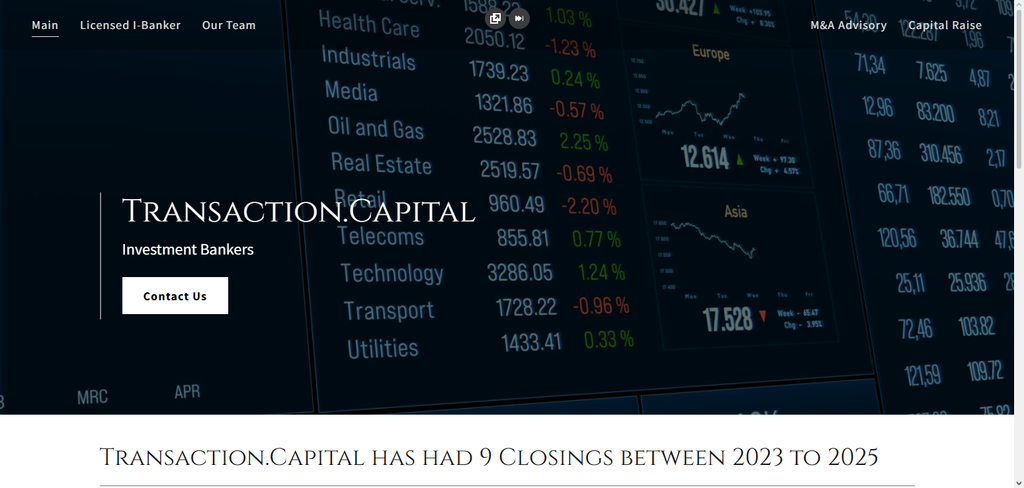
Transaction Capital LLC’s offerings include valuation analysis for sell-side and buy-side transactions, fairness opinions, and deal advisory for the lower middle-market. Transaction Capital LLC is retained by owners looking to either sell their business or obtain growth capital because the firm’s valuation work is integrated with transaction execution as opposed to typical compliance-related work.
Industry Strength: Lower middle-market businesses spanning several segments
Typical Client Stage: Business owners in preparation for sale, capital raise, or exit
Geographic Reach: Primarily domestic/regional with some select cross-border deals
Best Use Case: Valuations for active M&A deals
Key Strength: Integrated valuation and deal execution and negotiation
Potential Limitation: Not appropriate for valuation work that is purely compliance or audit-related
Transaction Capital LLC Features
| Feature | Details |
|---|---|
| Founded | Varies (boutique advisory firm, specific date unverified) |
| Headquarters | Regional (varies by firm entity) |
| Core Services | Sell-side/buy-side valuation, fairness opinions, deal structuring |
| Industry Focus | Diverse lower middle-market sectors |
| Client Size | Business owners preparing for sale, capital raise, or exit |
| Global Presence | Primarily domestic/regional |
| Technology | Deal-focused valuation and negotiation support tools |
| Regulatory Expertise | Limited compliance depth; transaction-focused rather than audit-focused |
| Pricing Tier | Mid-range, transaction-fee based models common |
| Turnaround Time | Fast, aligned with deal timelines |
8. Charles River Associates
Founded in 1965 in Boston Massachusetts, Charles River Associates (CRA) began as an economic consulting firm. Now CRA is a global leader in litigation, finance, and valuation consulting.

CRA provides valuation services that are primarily for litigation support and valuation of intellectual property, assessment of damages, and complex financial and economic analysis for disputes. CRA is engaged by law firms and corporations for high-stakes litigation for which their economic modeling demands expert testimony.
The caliber of CRA’s economists and industry experts sets CRA apart and makes them a preeminent choice for valuation related services pertaining to litigation, antitrust, and regulatory matters.
Industry Strength: Heavily litigated industries – pharmaceuticals, antitrust, and IP
Typical Client Stage: Corporations and law firms engaged in disputes or proceedings
Geographic Reach: Global, with substantial Presence in the U.S., UK, and Europe
Best Use Case: Valuations for litigation support, assessment of damages, and provision of expert testimony
Key Strength: Strong academics, quality of analysis, and defensible positions
Potential Limitation: Narrower focus makes it less suitable for general purpose financial reporting valuations
Charles River Associates (CRA) Features
| Feature | Details |
|---|---|
| Founded | 1965 |
| Headquarters | Boston, Massachusetts, USA |
| Core Services | Litigation support, damages assessment, IP valuation, expert testimony |
| Industry Focus | Pharmaceuticals, antitrust, intellectual property |
| Client Size | Corporations and law firms in disputes/regulatory matters |
| Global Presence | Strong in U.S., UK, and Europe |
| Technology | Advanced econometric and statistical modeling |
| Regulatory Expertise | Deep expertise in litigation, antitrust, and regulatory economics |
| Pricing Tier | Premium/high-cost (specialized expertise) |
| Turnaround Time | Varies significantly based on case complexity |
9. Houlihan Lokey Valuation
Houlihan Lokey started it’s business operations in 1972 and is a leading valuation firm in mergers and acquisitions. The firm’s expertise in restructuring services complements its practice in M&A valuation.

Houlihan’s Portfolio Valuation and Financial Opinions practice is experienced in rendering fairness and solvency opinions, purchase price allocations, and portfolio valuations. Houlihan is often employed to render valuations in matters before courts and/or boards where reliance is placed on independence and defense ability.
Houlihan is an ideal choice in such situations due to its independent status (without audit conflicts). Houlihan is well recognized for its valuation of complex alternative investments and distressed companies.
Industry Strength: Private equity, hedge funds, distressed companies, and alternative investments
Typical Client Stage: Institutional investors, PE/VC funds, and companies in restructuring
Geographic Reach: Global investment banking presence, strong in the U.S. and Europe
Best Use Case: Valuing illiquid and complex assets, as well as fairness and solvency opinions
Key Strength: Value of Independence from audit conflicts, particularly for high impact board decisions
Potential Limitation: Accessibility is more constrained for smaller enterprises
Houlihan Lokey Valuation Features
| Feature | Details |
|---|---|
| Founded | 1972 |
| Headquarters | Los Angeles, California, USA |
| Core Services | Fairness opinions, solvency opinions, portfolio valuation, PPA |
| Industry Focus | Private equity, hedge funds, distressed companies, alternative investments |
| Client Size | Institutional investors, PE/VC funds, restructuring companies |
| Global Presence | Strong in U.S. and Europe, growing in Asia |
| Technology | Specialized illiquid asset and complex security valuation models |
| Regulatory Expertise | Independent, audit-conflict-free valuation opinions |
| Pricing Tier | Premium/high-cost |
| Turnaround Time | Moderate, prioritized for high-stakes deals |
10. Duff & Phelps (Kroll)
Duff & Phelps started operations in valuation services in 1932, providing investment research and restructuring and risk advisory services. More recently, the firm has consolidated its valuation, compliance, cyber risk, and financial advisory into a unified practice under Kroll.

Kroll’s valuation services comprise financial reporting and tax valuations as well as real estate and machinery appraisals and valuations of complex securities.
Kroll continues to enjoy an excellent reputation as a premier vendor of highly sophisticated valuation services backed by specialized methodology that is developed and refined over several decades, thereby ensuring audit readiness.
Industry Strength: Financial services, real estate, technology, and regulated industries
Typical Client Stage: Private equity firms, corporations, and institutional clients
Geographic Reach: Global, expanded reach following Kroll integration for risk/compliance
Best Use Case: Tax valuations, securities pricing, financial reporting valuations for audit purposes
Key Strength: Allows for the application of decades of refined valuation techniques and an expertise of great breadth
Potential Limitation: Change to Kroll brand may create confusion for clients with legacy recognition of “Duff & Phelps”
Duff & Phelps (Kroll) Features
| Feature | Details |
|---|---|
| Founded | 1932 (rebranded to Kroll in 2021) |
| Headquarters | New York, USA |
| Core Services | Financial reporting valuation, tax valuation, real estate/machinery appraisal |
| Industry Focus | Financial services, real estate, technology, regulated industries |
| Client Size | Private equity firms, corporations, institutional clients |
| Global Presence | Global, expanded via Kroll risk/compliance integration |
| Technology | Proprietary methodology combined with Kroll’s risk analytics |
| Regulatory Expertise | Deep technical expertise in audit-ready valuations |
| Pricing Tier | Premium/high-cost |
| Turnaround Time | Moderate, efficient for standard compliance valuations |
Conclusion
The choice in valuation firm depends on the characteristics of the company needing a valuation. For instance, large, international firms will want to work with a firm that can deliver audit-defensible reports and has a global footprint, like the Big Four firms (PwC, EY, KPMG, and Deloitte). Mid-market firms, like Grant Thornton, can deliver specialized services at a low cost.
Specialized firms, including Houlihan Lokey and Duff & Phelps (Kroll) are leaders in higher impact financial opinions and valuations of illiquid assets. In cases of higher litigation, CRA is a leader.
Smaller firms may use Biz Valuations or Transaction Capital LLC. For transactions, smaller firms may choose Biz Valuations or Transaction Capital LLC. In order to obtain a credible valuation that meets your business objectives, you must select a firm whose expertise matches your business objectives.
FAQ
What is a business valuation firm?
A business valuation firm is a professional services company that determines the economic value of a business or its assets. These firms use standardized methodologies to support M&A transactions, financial reporting, tax compliance, litigation, and strategic planning.
How much does it cost to hire a valuation firm?
Costs vary widely based on firm size and complexity. Big Four firms (PwC, EY, KPMG, Deloitte) typically charge premium rates for large or complex engagements, while boutique or small business-focused firms like Biz Valuations offer more affordable options for smaller transactions.
How long does a business valuation take?
Timelines depend on complexity and firm size. Simple valuations from smaller firms may take days to a few weeks, while complex multinational valuations from Big Four firms can take several weeks to months.
Which valuation firm is best for small businesses?
Firms like Biz Valuations and Transaction Capital LLC are better suited for small and lower middle-market businesses, offering cost-effective, practical valuations without the premium pricing of larger global firms.
What’s the difference between Big Four valuations and boutique firm valuations?
Big Four firms offer global reach, deep regulatory expertise, and audit-ready documentation, ideal for large or multinational companies. Boutique firms often provide more personalized service, faster turnaround, and lower costs, better suited for mid-sized or smaller businesses.