





In this article, I analyze the leading FHE Encrypted Dark Pool Crypto Exchanges innovating private digital asset trading with advanced encryption, zero-knowledge proofs, and confidential computing techniques.
These privacy-centered services safeguard trading methods, minimize front-running worries, and facilitate secure institutional-level trades as they explore the emerging landscape of encrypted blockchain-linked financial systems.
What Are FHE Encrypted Dark Pool Crypto Exchanges?
FHE Encrypted Dark Pool Crypto Exchanges are new trading platforms that focus on privacy. The advanced cryptographic technologies and Fully Homomorphic Encryption (FHE) allow safe trading without exposing sensitive market data.
Trading platforms currently on the market show order books, trade volumes, and reveal the movements of trading liquidity. For trading habits that require discretion and large trade sizes, encrypted dark pools allow users to conceal their order details, trading strategy, and the asset being traded.
FHE allows computing to be done directly to encrypted data, therefore the system can both process and verify a transaction without showing the original data.
These platforms integrate different technologies that help to reduce the risks of front-running and MEV attacks as well as market manipulation, such as encryption, zero knowledge proofs, secure multiparty computations, and confidential executions.
For large institutional and hedge fund crypto trading that is risk-sensitive and needs discretion, ultra-security, and optimal digital asset execution, encrypted dark pools in 2026 are an accepted solution.
How We Evaluate the Best FHE Encrypted Dark Pool Crypto Exchanges
| Evaluation Factor | Weight | What We Analyze |
|---|---|---|
| Encryption Technology & Privacy Architecture | 20% | Evaluates the use of FHE (Fully Homomorphic Encryption), zero-knowledge proofs (ZKPs), MPC, TEEs, and other privacy technologies to protect trading data and encrypted transactions. |
| Transaction Confidentiality | 15% | Measures how effectively the platform hides order details, wallet activity, trading strategies, liquidity information, and user identities from public exposure. |
| Security Infrastructure | 15% | Analyzes smart contract security, cryptographic protection, network resilience, vulnerability prevention, and protection against attacks such as front-running and MEV exploitation. |
| Scalability & Performance | 10% | Reviews transaction speed, processing capacity, computational efficiency, and the ability to handle institutional-level trading volumes. |
| Private Order Matching System | 10% | Evaluates how efficiently the platform matches encrypted buy and sell orders without revealing sensitive trading information before execution. |
| Liquidity & Market Efficiency | 10% | Examines available liquidity, trading efficiency, settlement mechanisms, and the ability to support large-volume trades with minimal market impact. |
| Smart Contract & DeFi Compatibility | 5% | Measures support for programmable financial applications, confidential smart contracts, decentralized finance integrations, and automated trading solutions. |
| Institutional Readiness | 5% | Reviews enterprise features, compliance capabilities, custody support, and suitability for hedge funds, asset managers, and professional traders. |
| Cross-Chain Capability | 5% | Evaluates blockchain interoperability, multi-chain support, and the ability to enable private transactions across different networks. |
| Ecosystem Growth & Adoption | 5% | Considers developer activity, partnerships, community adoption, network maturity, and future growth potential. |
Benefits of Using FHE Encrypted Dark Pool Exchanges
Improved Trade Privacy
- Trading using FHE protected dark pool exchanges allows traders to keep details such as order size, trading strategy, wallet balances, and liquidity positions private.
- Data privacy is achieved by shielding the data, and still ensuring the data is verified and executed.
Shield Against Front-Running
- With dark pool exchange orders hidden from the public, the opportunity for malicious traders and bots to utilize upcoming transaction opportunities is minimal.
- This protects against a majority of MEV attacks, sandwich attacks, and trading advantage discrepancies.
Private Institutional Trading
- Large traders, hedge funds, and financial institutions can trade large amounts of cryptos without revealing trade intentions.
- Visibility privacy protects trades, and minimizes the market impact, and keeps trade strategies private from competitors.
Secure Encrypted Order Matching
- With FHE tech, private order matching systems process encrypted orders without ever handling the plaintext.
- This keeps the system and the processes protecting buyer and seller privacy intact.
Less Market Manipulation
- Dark pools and hidden liquidity, shielded trading, make price tricking and analyzing large volume market movements almost impossible.
- Trading within dark pools creates a shielded and safe trading environment.
Better Data Protection
- With FHE encrypted exchanges, user data is processed and maintained in an encrypted state.
- Blockchain based transactions carry visibility, and this reduces the risks of user private data being exposed.
Better Liquidity Management
- Trading liquidity gives institutions the ability to access private pools and conduct large trades without moving the market. This leads to better trade execution.
- This improves the trade of high value crypto.
Increased Institutional Adoption of Crypto
- Privacy focused trading infrastructure eases the major concerns institutions have when investing, such as privacy, safety, and legality.
- FHE dark pools provide the tools necessary to integrate digital assets into traditional finance.
Enhanced Compliance Potential
- Technological advances in privacy protection give traditional finance the ability to provide regulated services while keep user personal information private.
- This gives the user the ability to keep their transactions private, while also meeting the information demands of the government.
Key Point & Best FHE Encrypted Dark Pool Crypto Exchanges
| FHE Encrypted Dark Pool Crypto Exchange / Protocol | Key Points |
|---|---|
| Polygon Miden Dark Pool | • Uses zero-knowledge technology to enable private transactions and confidential trading.• Designed for privacy-focused Web3 applications with client-side proving architecture.• Helps hide sensitive transaction details while maintaining blockchain verification.• Suitable for institutional traders requiring private settlement environments. |
| Aleph Zero Liminal | • Privacy infrastructure combining zero-knowledge proofs and secure computation for confidential DeFi.• Enables private asset transfers, encrypted data processing, and compliant financial applications.• Supports enterprise-grade privacy without sacrificing blockchain transparency.• Designed for confidential trading and institutional digital asset management. |
| Secret Network Dark Pool | • Provides encrypted smart contracts that keep transaction data private during execution.• Uses privacy-preserving computation for confidential DeFi operations.• Allows users to interact with private assets and applications without exposing sensitive data.• Useful for privacy-focused trading strategies and hidden liquidity solutions. |
| Anoma Protocol | • Intent-based architecture that enables private and decentralized transaction matching.• Uses encrypted intents to protect user strategies before settlement.• Supports private liquidity discovery and customizable trading environments.• Reduces information leakage compared with traditional transparent DEX models. |
| Shardeum Dark Liquidity | • Focuses on scalable blockchain infrastructure with privacy-enhanced transaction capabilities.• Uses dynamic state sharding to improve scalability for high-volume applications.• Can support confidential liquidity solutions through privacy layers.• Targets efficient and low-cost decentralized financial applications. |
| zkSync Dark Pool | • Uses zero-knowledge rollup technology for scalable and privacy-focused transactions.• Enables faster settlements while reducing exposure of trading activity.• Supports confidential DeFi applications through zk-based infrastructure.• Helps institutions execute large trades with reduced market impact. |
| StarkNet Encrypted Pools | • Built on STARK-based zero-knowledge proofs for secure and scalable transactions.• Enables privacy-preserving applications without requiring trusted setups.• Supports advanced DeFi mechanisms including private liquidity pools.• Provides cryptographic security for confidential trading environments. |
| Aztec Connect Dark Pool | • Privacy-focused infrastructure designed for confidential DeFi interactions.• Uses zero-knowledge proofs to hide transaction details and user activity.• Enables private lending, swapping, and liquidity operations.• Helps protect traders from front-running and transaction surveillance. |
| Mina Protocol Pools | • Uses a lightweight blockchain architecture with zero-knowledge proof technology.• Enables privacy-focused applications with minimal blockchain data exposure.• Supports secure verification of transactions without revealing sensitive information.• Provides a foundation for privacy-enhanced decentralized finance solutions. |
| Phala Network Dark Pool | • Uses trusted execution environments (TEEs) for confidential computation.• Enables encrypted data processing and privacy-preserving smart contracts.• Supports secure DeFi applications requiring hidden transaction logic.• Useful for private liquidity management and confidential Web3 services. |
1. Polygon Miden Dark Pool
Polygon Miden Dark Pool is an infrastructure to facilitate privacy-focused trading. It takes advantage of the native zero-knowledge capability of Polygon Miden.
Traditionally, information of transactions in blockchains is made available to all. However, in Polygon Miden, users of the blockchain can generate proofs privately. Hence, it is fit for dark pool trading scenarios, where traders can place large orders and protect their balances, identities of counterparties, and their trading strategies.
The protocol provides a confidential transaction execution model, along private smart contracts and settlement. Best FHE Encrypted Dark Pool Crypto Exchanges like Polygon Miden Dark Pool are the first of their kind to offer privacy in a blockchain-based trading environment for institutional participants.
Features:
- Private blockchain transactions using a zero-knowledge-based architecture.
- Client-side proving allows users to generate proofs without revealing private data.
- Supports confidential smart contracts and private transfers.
- Scalable Web3 applications designed with enhanced privacy.
- Compared to public blockchains, reduces the amount of transaction data exposed.
Pros:
- Privacy protection mainly focused on ZK technology.
- Increases the security of institutional trading strategies.
- Lessens the risks of front-running and MEV attacks.
- offers an infrastructure that is scalable for future DeFi applications.
- Provides the ability to verify transactions privately.
Cons:
- Not a pure FHE-based trading solution.
- In its early stages, the technology is still developing and evolving.
- Has had very limited adoption compared to traditional exchanges.
- More complex ZK infrastructure increases the challenges for developing applications.
- Lacks a sufficient ecosystem to support liquidity.
2. Aleph Zero Liminal
Aleph Zero Liminal offers privacy through advanced cryptography for blockchain interactions. It employs the combination of zero-knowledge proofs and secure multiparty computation (sMPC) to guarantee privacy in transactions.
Such an approach empowers developers to create private DeFi, confidential transactions of assets, and private liquidity systems similar to dark pool trading.
In contrast to most trading systems, where the details of an order potentially expose the trader to the risk of front-running, Liminal aims to provide a system where transactions are protected while providing the assurance of a verifiable blockchain.
Aleph Zero Liminal is one of the Best FHE Encrypted Dark Pool Crypto Exchanges with an enterprise-class privacy focus due to its combination of multiple encryption techniques and hybrid approaches.
Features:
- Uses zero-knowledge proofs and secure multiparty computation.
- Provides privacy layers for DeFi, enterprise, and other applications.
- Allows the processing of sensitive data in a secure environment.
- Designed for compliance-friendly blockchain privacy.
Pros:
- Blockchain privacy is enhanced using advanced hybrid technology.
- Designed for the needs of the institution.
- Protects the details of transactions and the private data of users.
- Decreases the risks of transparency and privacy issues in blockchain technology.
- Allows confidential development in Web3.
Cons:
- Hybrid privacy technology can be complex.
- Smaller ecosystem compared to major blockch
- Privacy computing affects performance.
3. Secret Network Dark Pool
Secret Network Dark Pool is a confidential smart contract platform for private data. The network uses encrypted computation to hide a range of private information pertaining to trading strategies and balances along with transaction parameters.
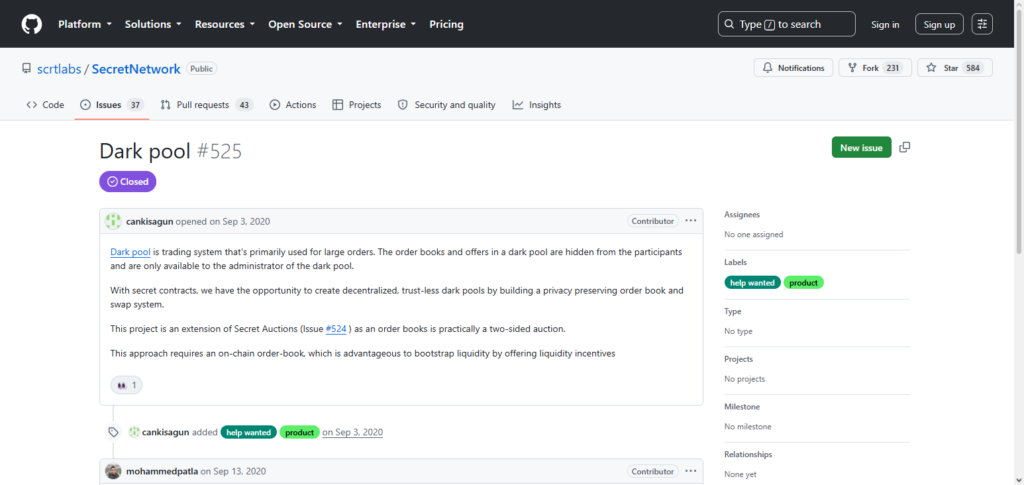
To facilitate large institutional trades, this technology can securely execute dark pool-style crypto trades, which avoid the dissemination of market-sensitive information. Secret Network also supports the creation of private DeFi applications, which grants users the ability to execute confidential transactions.
It achieves this through the use of encrypted digital assets and smart contracts. Secret Network Dark Pool is one of the Best FHE Encrypted Dark Pool Crypto Exchanges, and it has established a private trading infrastructure to provide data confidentiality and reduce the risk of information leakage.
Features:
- Has encrypted smart contracts to handle confidential transactions.
- Secures trading data, balance information, and user data.
- Supports confidential DeFi.
- Has interactions of encrypted assets.
- Has secret contracts for privacy.
Pros:
- Strong privacy centric focus on blockchain.
- Privacy protecting users from transactional surveillance.
- Lessens front-running.
- Encrypts financial applications.
- Has a privacy centric ecosystem.
Cons:
- Privacy regulations may slow adoption.
- Lower liquidity compared to large DeFi platforms.
- Privacy technology demands a steep learning curve.
- Limited integration with institutions.
- Network activity relies on ecosystem development.
4. Anoma Protocol
Anoma Protocol created an intent-based architecture to improve privacy and decentralized transaction coordination. There is no need to disclose transaction information because Anoma users publish encrypted intents. Here, intents compete for privacy and are resolved in a final settlement.
This model is applicable to dark pool trading because intents describe what institutional investors want but do not unveil strategies and order information. Best FHE Encrypted Dark Pool Crypto Exchanges Anoma Protocol focuses on private intent discovery, encryption, and flexible execution.
Because privacy is achieved through intent-based architecture instead of the order-book system, Anoma reduces frontrunning and manipulation of the market.
Features:
- Has a decentralized transaction structure based on intent.
- Allows private matching of intent before settlement.
- Has a trading environment that is adjustable.
- Reduces leakage of information during transactions.
- Is focused on privacy centric decentralized applications.
Pros:
- Provides an innovative approach to private transaction matching.
- Reduces the exposure to front-running MEV.
- Protects trading strategies.
- Is flexible.
- Is adaptable to advanced DeFi.
Cons:
- Remains an innovative blockchain architecture.
- Using it is complex for most users.
- Dark pools adoption is limited.
- Needs a developer ecosystem.
- Stil pending infrastructure.
5. Shardeum Dark Liquidity
Shardeum introduced a privacy-centric dark liquidity model built around a scalable blockchain. Their focus on state sharding allows dynamic and efficient processing of large volumes of transactions. For future dark pool applications, fast settlements, low costs, and privacy for liquidity management are imperative for institutional traders.
A dark liquidity model based on Shardeum could provide encrypted trading for participants, allowing them to maintain privacy of sensitive market information. Shardeum Dark Liquidity is among Best FHE Encrypted Dark Pool Crypto Exchanges, serving as an example of utilizing scalability, privacy, and decentralization in financial services.
Features:
- Has dynamic state sharding for better scalability.
- Supports a lot of transactions per second.
- Has in mind building blockchain apps that are less expensive.
- Provides the foundation for tools for private liquidity.
Pros:
- High scalability potential.
- Reduced transaction costs.
- Built for large-volume applications.
- Developer-friendly blockchain.
- Privacy integrations.
Cons:
- No FHE dark pool.
- Privacy limited.
- Small ecosystem, compared to Ethereum.
- No big company use.
- New tech, means lots of testing.
6. zkSync Dark Pool
zkSync Dark Pool makes use of the zero-knowledge roll-up technology to provide privacy and scalability for blockchain transactions. zkSync’s ZK-based architecture ensures that certain information is not revealed, enabling a variety of systems for confidential trading.
zkSync-based dark pools can provide large trading opportunities for institutions while mitigating the negative effects of trading order visibility, front-running, and public markets. Its low-cost, high-speed transactions, and a focus on cryptographic security make zkSync appropriate for a privacy-focused decentralized finance (DeFi) ecosystem.
Within the class of Best FHE Encrypted Dark Pool Crypto Exchanges, zkSync Dark Pool is a strong example of how zero-knowledge technology can provide safe and more private trading solutions for institutions.
Features:
- Uses zero-knowledge rollup technology.
- Can do private and scalable transactions on a blockchain.
- Does fast settlement at low cost.
- Offers a way to make DeFi apps private.
- Protects trading info.
Pros:
- Good scalability for ZK rollups.
- Cheaper than Layer 1 transactions.
- Less exposure for trading data.
- Compatible with Ethereum.
- Meant for institutional DeFi.
Cons:
- Mostly ZK, not pure FHE.
- Depends on app design for privacy.
- Needs more adoption to add dark pools.
- Is challenging for new users.
- Has liquidity fragmentation issues.
7. StarkNet Encrypted Pools
StarkNet Encrypted Pools are based on StarkWare’s STARK technology, which provides scalable solutions for performing secure verification through advanced cryptographic proofs. These encrypted pool concepts aim to give users access to DeFi without disclosing their full trading information.
StarkNet’s technology helps application developers to maintain a clear separation between the verification of transactions and the exposure of sensitive information. In dark pool trading, this can mitigate the MEV attacks, front-running, and copying trading strategies.
Within the class of Best FHE Encrypted Dark Pool Crypto Exchanges, StarkNet Encrypted Pools provides a scalable solution for confidential decentralized markets.
Features:
- Uses STARK zero-knowledge technology.
- Offers secure transaction verification.
- Has scalable apps.
- Private liquidity pools.
- Has no trusted setups.
Pros:
- Strong cryptography.
- Good scalability.
- Protects trading data.
- Done for advanced DeFi.
- Uses proof verification.
Cons:
- Not a stand-alone dark pool.
- Programming skills needed.
- Few privacy use cases.
- Still growing adoption.
8. Aztec Connect Dark Pool
The Aztec Connect Dark Pool uses an actual dark pool for traditional finance. Compared to traditional dark pools, this technology provides DeFi applications which allow participants to maintain their privacy when dealing with sensitive trade information.

This technology uses anonymous interactions with DeFi applications to conceal sensitive transaction data from an observer on a public blockchain. AztecConnect Dark Pool uses private transactions on a public blockchain.
Compared to other Best FHE Encrypted Dark Pool Crypto Exchanges, Aztec Connect Dark Pool maintains the privacy of users from surveillance, front-running, and data exposure.
Features:
- Confidential DeFi structure.
- Utilizes zero-knowledge to secure transactions.
- Keeps user balances and transaction details safe.
- Users can build confidential financial applications.
- Designed for private interactions on a blockchain.
Pros:
- Strong privacy focus.
- Helps avoid transaction monitoring.
- Supports secure DeFi.
- Minimizes front-running.
- Uses advanced encryption.
Cons:
- Clunky infrastructure.
- Not widely used.
- Developer friendliness takes a hit.
- Privacy laws affect usage.
- Needs more support.
9. Mina Protocol Pools
Mina Protocol Pools support a variety of privacy-enhanced decentralized applications (dapps) using a scalable, zero-knowledge blockchain. Mina offers developers a unique opportunity to build applications using a blockchain to verify sensitive information without exposing all of the required data.
On the contrary, based on the privacy-first design of the Mina network, dark pools can support confidential trading in financial environments where users can prove transactions without sharing financial details.
Mina Protocol Pools, one of the Best FHE Encrypted Dark Pool Crypto Exchanges, prove with zero-knowledge evidence that Mina can build private and secure financial networks.
Features:
- Zero-knowledge proofs for a blockchain that requires lightweight verse.
- Verifies information without revealing all data.
- Has privacy-preserving apps.
- Stays light on storage to hold blockchain data.
- Verifies data securely.
Pros:
- Blockchain architecture makes privacy and efficiency easy to achieve.
- Takes little space for storage.
- Supports ZK apps and ensures privacy.
- Has a decentralized verification method.
Cons:
- Not specifically built for dark pool trading.
- Low DeFi liquidity.
- Not heavily used.
- Less Institutions use it.
- Privacy relies on application build.
10. Phala Network Dark Pool
Phala Network Dark Pool leverages confidential computing with Trusted Execution Environments (TEEs) to protect sensitive operations on blockchains. Computations can be performed on private data in an encrypted manner, so Phala Network does not require sharing information publicly.

This technology can support dark pool trading systems by concealing trading algorithms, order information, and sensitive financial data from external observers. Phala Network’s confidential computing creates opportunities for privacy-preserving DeFi, institutional finance, and secure data applications.
Phala Network Dark Pool is considered one of the Best FHE Encrypted Dark Pool Crypto Exchanges, and is the first blockchain technology and private and secure dark pool-based digital asset trading service.
Features:
- Uses trusted execution environments (TEEs).
- Enables confidential smart contract execution.
- Supports encrypted data processing.
- Provides privacy-focused Web3 infrastructure.
- Enables secure computation without exposing data.
Pros:
- Strong confidential computing capabilities.
- Protects sensitive financial information.
- Supports enterprise privacy solutions.
- Enables secure AI and blockchain applications.
- Flexible privacy infrastructure.
Cons:
- TEE-based security has hardware dependencies.
- Not a pure FHE solution.
- Requires technical expertise.
- Adoption is still developing.
- Security depends on trusted hardware environments.
Conclusion
The Best FHE Encrypted Dark Pool Crypto Exchanges pioneer privacy-centric trading with the use of sophisticated cryptography, zero knowledge proofs, secure computation and encrypted execution.
Platforms like Polygon Miden, Aleph Zero Liminal, Secret Network, Anoma, zkSync, StarkNet, Aztec, Mina Protocol, and Phala Network show how blockchain technology is moving in the direction of confidential trading where users can keep their trade secrets like transaction details, liquidity and trading strategies.
In traditional trading, orders carry the risk of front-running, MEV attacks, and Strategy exposure. Dark pools aim to solve these problems providing secure execution and minimal information leak. While the use of fully homomorphic encryption (FHE) in crypto trading is at a very nascent stage, they give the basis for institutional grade markets.
As compliance and privacy with scalability becomes a hallmark of infrastructure in digital assets in 2026, FHE-powered and privacy-centric dark pools may become a pillar of decentralized finance. The future of electronic trading will revolve around finding the right balance of the three conflicts of transparency, security and privacy to provide seamless, secure services to both institutions and individual users on a blockchain.
FAQ
What are FHE Encrypted Dark Pool Crypto Exchanges?
FHE Encrypted Dark Pool Crypto Exchanges are privacy-focused trading platforms that use Fully Homomorphic Encryption (FHE) or related cryptographic technologies to protect sensitive trading information. Unlike traditional exchanges where order size, price, and liquidity details can become visible, FHE-based systems allow computations to be performed on encrypted data without revealing the original information. This helps traders execute large transactions privately while reducing risks such as front-running, market manipulation, and strategy exposure.
How does FHE technology improve crypto dark pool trading?
FHE improves crypto dark pool trading by allowing matching engines and smart contracts to process encrypted orders without decrypting them. This means buy and sell information, trading amounts, and user strategies can remain confidential throughout execution. The technology creates a secure environment where institutions can perform calculations on protected data while maintaining blockchain verification. This approach is designed to improve privacy, security, and trust in decentralized financial markets.
What are the benefits of using FHE encrypted dark pools?
The main benefits of FHE encrypted dark pools include reduced front-running risk, improved institutional privacy, lower market impact for large trades, and confidential liquidity management. Large investors can execute significant transactions without immediately revealing their intentions to the public market. These systems can also support private DeFi applications, encrypted order matching, and secure financial operations while maintaining decentralized infrastructure.