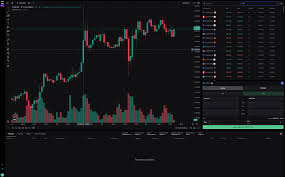

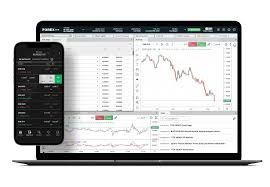

This article discusses about the Best Forex Factor Analysis Platforms to help you analyze currency market drivers, assess risk factors and create quantitative trading rules.
- Key Point & Best Forex Factor Analysis Platforms
- 1. MSCI Barra FX Factor Models
- MSCI Barra FX Factor Models –Components
- MSCI Barra FX Factor Models
- 2. Refinitiv Eikon + Datastream
- Refinitiv Eikon + Datastream – Features
- Refinitiv Eikon + Datastream
- 3. Morningstar Direct FX Analytics
- Morningstar Direct FX Analytics — Features
- Morningstar Direct FX Analytics
- 4. Axioma Risk (Qontigo)
- Axioma Risk (Qontigo) – Features
- Axioma Risk (Qontigo)
- 5. FactSet Quantitative Research Suite
- FactSet Quantitative Research Suite – Features
- FactSet Quantitative Research Suite
- 6. SAS Risk Management
- SAS Risk Management – Features
- SAS Risk Management
- 7. Numerix Analytics
- Numerix Analytics – Features
- Numerix Analytics
- 8. SimCorp Dimension
- SimCorp Dimension – Features
- SimCorp Dimension
- 9. OpenGamma Risk Platform
- OpenGamma Risk Platform – Features
- OpenGamma Risk Platform
- 10. Python (QuantLib, Pandas, Statsmodels)
- Python (QuantLib, Pandas, Statsmodels) – Features
- Python (QuantLib, Pandas, Statsmodels)
- Conclusion
- FAQ
The systems offer value-added analytics, historical data and modeling frameworks aimed at improving trading decisions, increasing portfolio performance, and enabling data-based forex strategizing in today’s dynamic financial markets.
Key Point & Best Forex Factor Analysis Platforms
| Platform | Key Point |
|---|---|
| MSCI Barra FX Factor Models | Advanced institutional FX factor modeling focused on risk decomposition, portfolio optimization, and systematic currency exposure analysis. |
| Refinitiv Eikon + Datastream | Provides extensive historical macroeconomic and FX datasets with powerful analytics for factor research and strategy validation. |
| Morningstar Direct FX Analytics | Strong performance attribution and benchmarking tools for evaluating currency factor exposure across diversified portfolios. |
| Axioma Risk (Qontigo) | Multi-asset risk analytics platform offering stress testing, scenario analysis, and predictive factor risk modeling. |
| FactSet Quantitative Research Suite | Integrated research environment combining global market data, backtesting tools, and collaborative quantitative strategy development. |
| SAS Risk Management | Enterprise-grade analytics using statistical modeling and machine learning for currency risk assessment and regulatory reporting. |
| Numerix Analytics | Specializes in derivatives pricing and FX risk analytics with advanced valuation and scenario simulation capabilities. |
| SimCorp Dimension | End-to-end investment management system supporting portfolio construction, factor attribution, and currency exposure management. |
| OpenGamma Risk Platform | Open-architecture analytics platform enabling customizable FX factor models and real-time risk evaluation. |
| Python (QuantLib, Pandas, Statsmodels) | Flexible open-source ecosystem allowing traders to build custom FX factor models, automate analysis, and perform advanced statistical research. |
1. MSCI Barra FX Factor Models
MSCI Barra FX Factor Models are popular tools for institutional investors who study the characteristics of currency market via systematic risk factors (carry, momentum, volatility and value).
The solution offers a unique real-time view into macro-induced risks and exposures down to an individual portfolio, empowering users with deep levels of risk decomposition across their entire book. Its advanced analytics helps asset managers to create a diversified currency portfolio while managing their exposure.
Best Forex Factor Analysis Platforms: e.g., MSCI Barra which sits in the center of modern quantitative trading workflows to help traders detect hidden correlations and choose allocations. The system is particularly useful for hedge funds, sovereign institutions, and professional forex strategists looking for data-driven insights.
MSCI Barra FX Factor Models –Components
- Multi-Factor Currency Modeling: FX return drivers including carry, value, momentum and volatility factors.
- Risk Decomposition Analysis: Decomposes portfolio risk in to systematic and currency-specific factor exposures
- Portfolio Optimization Tools: Facilitates quantitative asset allocation and FX hedge optimizations strategies.
- Global Institutional Data Coverage: Offers deep historical datasets for both developed and emerging FX markets.
- Scenario & Stress Testing: Screens for currency portfolio sensitivity by simulating macroeconomic shocks
MSCI Barra FX Factor Models
| Pros | Cons |
|---|---|
| Institutional-grade multi-factor risk models | Very expensive licensing cost |
| Strong currency factor attribution analysis | Complex setup for beginners |
| Widely trusted by asset managers & hedge funds | Requires quantitative expertise |
| Advanced portfolio risk forecasting | Limited retail trader accessibility |
| Global macro and FX exposure insights | Customization may require support teams |
2. Refinitiv Eikon + Datastream
Refinitiv Eikon (together with Datastream) creates one of the most flexible and powerful environments for macroeconomic/ currency factor research. It provides traders with record coverage of historical FX data, economic indicators and cross-asset analytics for constructing factor models.
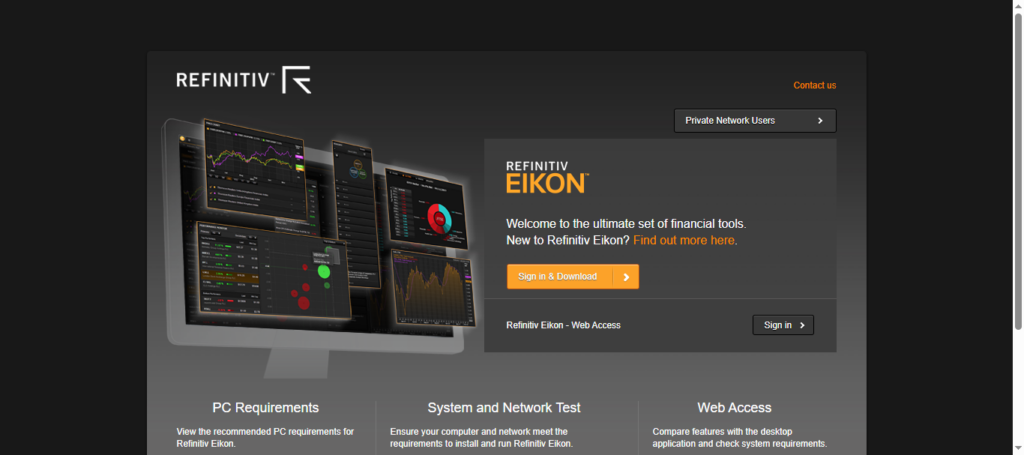
It allows quantitative analysts to test dollar drivers like interest rate spreads, inflation trends and global liquidity conditions. Refinitiv is well-regarded for its fast-moving analysis and unique visualisation tools, and it reigns supreme over Best Forex Factor Analysis Platforms.
Scenario analysis is conducted by portfolio managers, validating analytics and fundamental-based data with algorithm-generated activities provides more accurate forecasting in the market.
Refinitiv Eikon + Datastream – Features
- Real-Time FX Market Data: Pricing for institutional grade, macroeconomic indicators and currency analytics.
- Historical Time-Series Database: Data used for backtesting a factor and statistical modelingr (some of these are long-term datasets)
- Integrated Quantitative Analytics: Facilitates regression, correlation and factor performance testing.
Refinitiv Eikon + Datastream
| Pros | Cons |
|---|---|
| Massive historical FX and macroeconomic database | High subscription pricing |
| Real-time market analytics and research tools | Interface learning curve |
| Excellent data integration with Excel & APIs | Heavy system resource usage |
| Reliable institutional data quality | Overkill for small traders |
| Strong quantitative research environment | Requires data management skills |
3. Morningstar Direct FX Analytics
At Morningstar Direct, FX Analytics emphasizes performance attribution and the assessment of factor exposure in a range of global currency investments.
It allows traders to assess how systematic drivers such as risk sentiment, valuation signals or macro cycles impact forex returns over time. The platform combines investment research with reporting dashboards, making it relevant for institutions overseeing diversified portfolios.
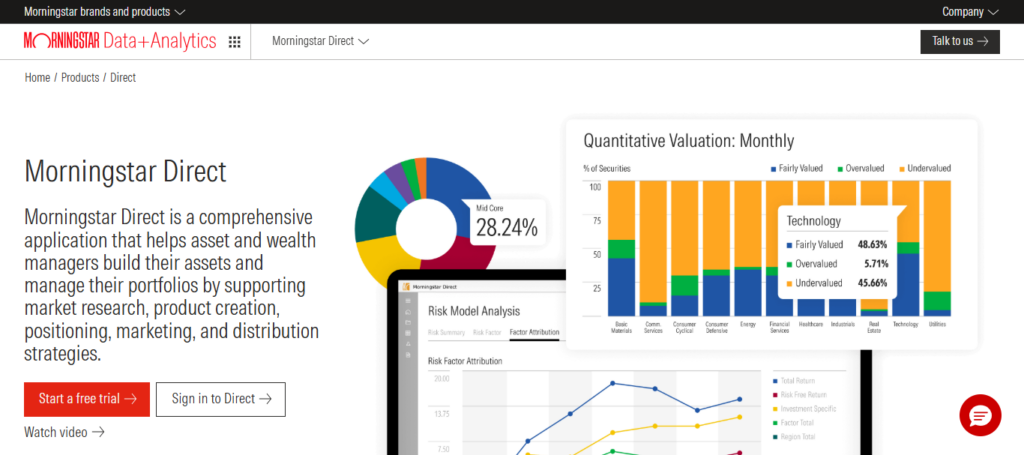
Sitting firmly within the Best Forex Factor Analysis Platforms category, Morningstar Direct integrates fundamental research with quantitative analytics in pursuit of strategic asset allocation choices.
A substantial advantage of these offerings for asset managers is in-depth benchmarking, multi-currency analysis, and automatic reporting capabilities which streamline complex factor modeling while introducing transparency into forex investment decisions.
Morningstar Direct FX Analytics — Features
- Factor Exposure Measurement: Assesses the reactions of currencies towards economic and valuation factors
- Portfolio Attribution Analysis: Breaks down performance into allocation, timing, and factor contributions.
- Institutional Research Tools: Now available for asset managers performing macro and currency work.
- Data Visualization Dashboards: Interactive charts aid in analysis interpretation.
- Cross-Asset Integration: Merges FX drivers with equities, bonds and macro-controls.
Morningstar Direct FX Analytics
| Pros | Cons |
|---|---|
| Clean and user-friendly analytics interface | Limited deep quantitative modeling |
| Strong portfolio and performance analytics | FX focus not as deep as equities |
| High-quality financial datasets | Premium subscription required |
| Easy reporting and visualization tools | Less customization flexibility |
| Good for investment research workflows | Not ideal for algorithmic trading |
4. Axioma Risk (Qontigo)
Specialized analysis of foreign exchange factor is made possible by Axioma Risk by Qontigo, which offers sophisticated cross-asset risk modeling.

The model assesses systematic risks associated with carry trades, global volatility shocks, and exposures to regional economies that drive currency portfolios. It allows traders to perform stress testing and predictive simulations for risk management in real time.
Axioma Risk, ranked amongst Best Forex Factor Analysis Platforms, empowers institutional traders to combine portfolio construction with optimization and risk forecasting in a single environment.
Its scalable architecture makes it well-suited for banks, asset managers and quantitative hedge funds seeking precise analytics and factor attribution over large FX portfolios.
Axioma Risk (Qontigo) – Features
- Advanced Risk Modeling Engine: Multi-asset factor risk models incorporating foreign exchange exposures.
- Factor-Based Portfolio Construction: Supports systematic currency strategy development.
- Stress Testing Framework: Risk Tests currency portfolios for extreme market conditions
- Performance Attribution Tools: It identifies factor alpha vs market beta performance.
- Cloud-Based Analytics Infrastructure: Survey of scalable computation for quantitative teams in a institution.
Axioma Risk (Qontigo)
| Pros | Cons |
|---|---|
| Advanced factor-based risk modeling | Enterprise-level pricing |
| Excellent portfolio stress testing | Requires professional training |
| Multi-asset and FX factor integration | Complex implementation process |
| Trusted by institutional investors | Not retail-trader friendly |
| Powerful scenario analysis tools | High infrastructure requirements |
5. FactSet Quantitative Research Suite
The FactSet Quantitative Research Suite also enables the integration of powerful data sources, run backtests and build factor models specifically designed for research teams and professional traders.
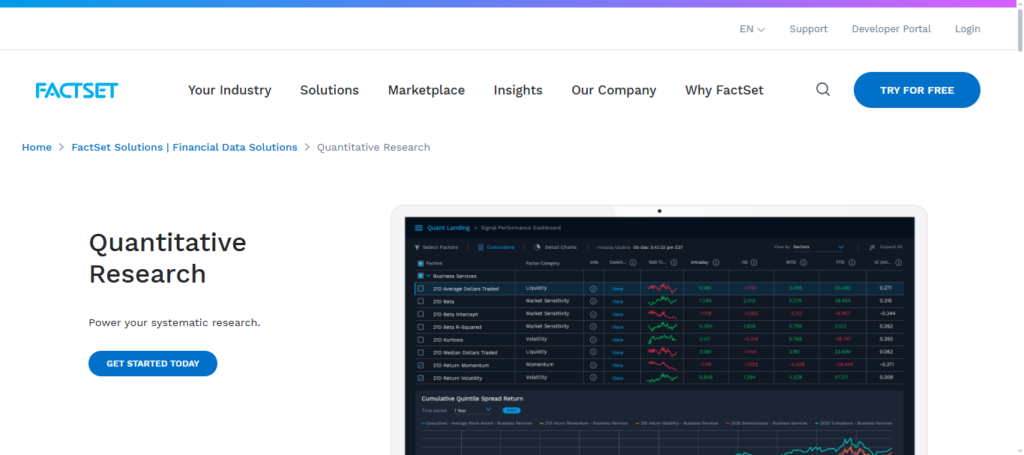
Through the integration of this global market data, analytics libraries and portfolio monitoring tools, the platform can identify key performance drivers for currencies. Analysts can also analyse the macroeconomic and geopolitical factors, momentum indicators, cross-asset relationships impacting forex markets.
As a leading provider of Best Forex Factor Analysis Platforms, FactSet supports collaborative research workflows in which teams can construct, test and iterate systematic trading strategies.
Enhanced with powerful API connectivity, it integrates seamlessly with Python and other quantitative tools, rendering itself highly adaptable to sophisticated forex research environments.
FactSet Quantitative Research Suite – Features
- Comprehensive Quant Research Environment: Integration of financial data, analytics, and modeling tools.
- Factor Screening Capabilities: Identifies FX signals through macro and statistical signals.
- Backtesting Framework: It backtests currency factor strategies using historical data.
- Integrated Data Management: Standardizes and cleans datasets for consistency across different sources.
- Python & API Connectivity: Allows automation of quantitative trading workflows.
FactSet Quantitative Research Suite
| Pros | Cons |
|---|---|
| Integrated research, analytics, and data platform | Expensive enterprise subscription |
| Strong factor research and attribution tools | Steep learning curve |
| Excellent visualization dashboards | Requires institutional workflows |
| API access for automation | Setup time can be long |
| Reliable global market datasets | Limited open-source flexibility |
6. SAS Risk Management
SAS Risk Management for Banking – an enterprise-class analytics platform for risk modeling and regulatory compliance for financial markets including foreign exchange.
The methodology applies advanced modeling and machine learning approaches to assess factor exposures that can impact currency portfolios. SAS is used by institutions to identify exposure to macroeconomic variables, liquidity risk and volatility dynamics.

In the enterprise trading infrastructures Best Forex Factor Analysis Platforms such as SAS enable organizations to do predictive risk assessments and scenario simulations.
Its automated reporting, governance controls, and scalable analytics engine help banks and financial institutions manage complex forex portfolios in compliance with tight regulatory architectures.
SAS Risk Management – Features
- Enterprise Risk Analytics: Measures FX exposure across institutions portfolios
- Predictive Modeling & AI Analytics: Machine learning based approach to detect currency risk pattern.
- Regulatory Risk Reporting: Has a framework that supports Basel and enterprise risk compliance
- Scenario Simulation Tools: Assessment of macro and liquidity stress scenarios.
- Centralized Data Governance: Guaranteeing safe and standard monetary data management.
SAS Risk Management
| Pros | Cons |
|---|---|
| Industry-leading risk analytics engine | Requires technical configuration |
| Advanced statistical modeling capabilities | High deployment cost |
| Strong regulatory compliance support | Needs specialized SAS knowledge |
| Scalable enterprise architecture | Not ideal for small trading desks |
| Robust scenario and stress testing | Implementation complexity |
7. Numerix Analytics
Its a derivatives and currency markets pricing, valuation, and risk analytics provider. The platform allows traders to model FX risk factors like volatility surfaces, interest rate differentials and structured product exposures.

Its advanced quantitative libraries allow analysts to simulate complex currency scenarios and stress test portfolios as market conditions evolve. Recognized for Best Forex Factor Analysis Platforms, Numerix provides sophisticated modeling requirement be retained by investment banks and institutional traders.
A fully integrated valuation analytics and real-time risk management system which helps traders understand complex relationships between multiple financial variables in global markets and their effects on forex trading strategies.
Numerix Analytics – Features
- Advanced Derivatives Modeling: Robust flow in FX OI and structured currency products.
- Risk & Valuation Analytics: Gets pricing sensitivities and factor impacts.
- Monte Carlo Simulation: Enables sophisticated FX scenario forecasting.
- Cross-Asset Risk Integration: FX risk analytics integrate rates,credit and derivatives.
- Institutional Quant Framework: Build for investment banks, hedge funds and asset managers
Numerix Analytics
| Pros | Cons |
|---|---|
| Strong derivatives and FX risk analytics | Premium institutional pricing |
| Accurate pricing and valuation models | Requires quantitative background |
| Excellent counterparty risk analysis | Limited beginner accessibility |
| Supports complex structured products | Setup can be technical |
| Institutional-grade scenario simulations | Smaller user community |
8. SimCorp Dimension
SimCorp Dimension is an integrated investment management platform for portfolio management, risk analysis and factor modeling. For forex trading, this allows institutions to assess currency exposure through macroeconomic and systematic risk drivers among multi-asset portfolios.

Traders can also assess performance attribution, hedging effectiveness, and factor contribution through a single lens. Cycles through Best Forex Factor Analysis Platforms, SimCorp Dimension serves large asset managers requiring centralised investment operations.
Its automation capabilities simplify workflow processes and provide rich analytical insights that enable investment teams to position currency strategies within the context of the wider portfolio and long-term risk management policy.
SimCorp Dimension – Features
- Front-to-Back Investment Platform: It combines portfolio management, risk and trading workflows.
- Factor-Based Risk Monitoring: Real-time tracking of currency exposure across portfolios
- Performance Attribution Analytics: Like FX factors and strategies Measures returns generated
- Automated Portfolio Rebalancing: Supports systematic FX allocation models.
- Enterprise Data Integration: Centralizes investment data across institutions.
SimCorp Dimension
| Pros | Cons |
|---|---|
| Complete investment and risk management solution | Very costly implementation |
| Strong portfolio and exposure analytics | Long onboarding process |
| Integrated trading and compliance tools | Requires enterprise infrastructure |
| Supports multi-currency portfolios | Overly complex for small firms |
| Automated reporting and workflow management | Customization needs specialists |
9. OpenGamma Risk Platform
OpenGamma Risk Platform – Open-architecture analytics system for derivatives and FX risk. It enables traders to construct customized factor models, analyze pricing sensitivities, and assess portfolio exposures based on sophisticated quantitative methodologies.
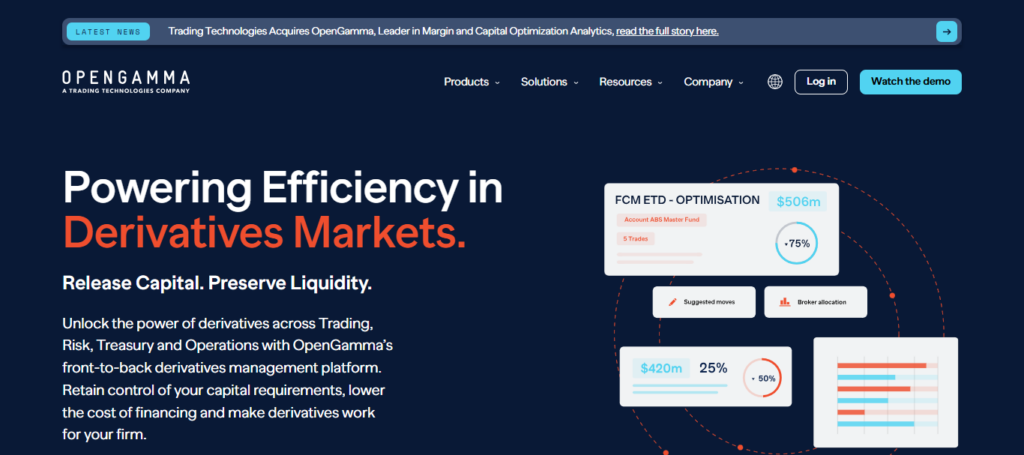
Its enterprised platform also supports real-time analytics that facilitate faster assessment of evolving market conditions. In the category of Best Forex Factor Analysis Platforms, OpenGamma is the leader on flexibility and transparency, especially for firms looking to adapt an open-source approach.
Quant teams use it when integrating proprietary models, automating analytics pipelines and scenario testing – which makes it a great fit for fintech firms, hedge funds and systematic trading desks.
OpenGamma Risk Platform – Features
- Open-Source Quant Analytics: YOU ARE NOT SURE WHAT TO DOBe an open and energy-efficient how to build the structure of a company.
- Risk Calculation Engine: Real-time valuation and sensitivity analysis.
- Derivatives & FX Analytics Support: Designed for complex currency instruments.
- Transparency & Customization: Risk models are easily changeable by developers.
- Cloud & API Integration: Enables scalable quantitative infrastructure.
OpenGamma Risk Platform
| Pros | Cons |
|---|---|
| Open-source flexibility | Requires programming expertise |
| Transparent risk analytics models | Limited commercial support |
| Good derivatives and FX valuation tools | Setup effort is high |
| Highly customizable analytics engine | Documentation learning curve |
| Cost-effective compared to enterprise tools | Requires internal development resources |
10. Python (QuantLib, Pandas, Statsmodels)
Our journey continues to deliver on its promise with python being one of the most widely used ecosystems for forex factor analysis thanks to its extensive array of open-source libraries.
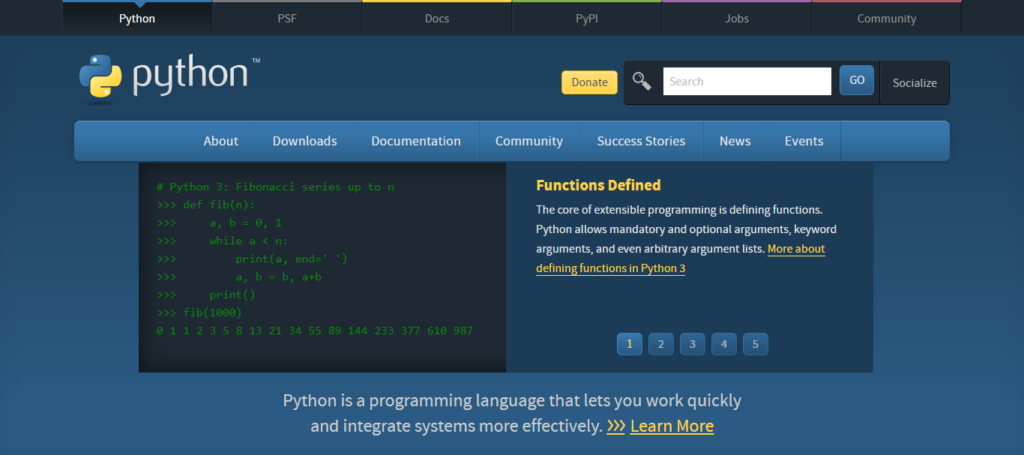
Pricing and financial modeling can be done using QuantLib, data manipulation is possible with Pandas while factor research involves statistical testing/regression analysis with Statsmodels. This allows traders to create fully customized FX factor models, backtest strategies and automate research workflows efficiently.
Python is one of the Best Forex Factor Analysis Platforms for modern algorithmic trading environments because it provides unlimited extent and integration features. Python is used by quantitative traders, researchers and developers alike to develop scalable, analytical forex strategies that cater to the individual needs of any specific trading target.
Python (QuantLib, Pandas, Statsmodels) – Features
- Full Custom Factor Modeling: Create proprietary FX factor strategies from scratch
- Advanced Statistical Analysis: Regression, time-series modelling and econometric testing.
- Backtesting & Automation: Acts as an automated strategy validate and signal generator.
- Massive Data Handling: Data up until October 2023 used in Pandas for large historical FX datasets.
- Open-Source Flexibility: Super flexible and backed by an international resource pool
Python (QuantLib, Pandas, Statsmodels)
| Pros | Cons |
|---|---|
| Completely customizable factor modeling | Requires coding skills |
| Free and open-source ecosystem | No built-in institutional data |
| Powerful statistical and machine learning tools | Setup takes time |
| Massive quant trading community support | Maintenance handled by user |
| Ideal for algorithmic and systematic strategies | Requires data engineering knowledge |
Conclusion
Data-driven currency strategies: An investor guide to Forex factor analysis platforms These platforms provide insights into key market drivers: momentum, carry, volatility and macroeconomic factors helping traders control risk better and refine forecasting.
(And of course, it runs parallel with the trading process as a whole) From institutional to more flexible solutions like MSCI Barra and FactSet for weekly turnover data and libraries from Python to be able to analyse each of these pairs with whatever you wish.
A strong data access, enhanced modeling and advanced risk analytics can synergize to streamline the forex trading decision process, improve portfolio performance and accelerate more repeatable and scalable trading strategies in today’s quantitative trading landscape.
FAQ
What are Forex factor analysis platforms?
Forex factor analysis platforms are advanced analytical systems that help traders identify currency performance drivers such as interest rate differentials, momentum, volatility, carry trade effects, and macroeconomic factors. These tools use quantitative models and statistical techniques to measure factor exposure and improve systematic trading strategies.
Why is factor analysis important in Forex trading?
Factor analysis helps traders understand why currencies move rather than simply predicting price direction. It improves risk management, portfolio diversification, alpha generation, and strategy validation by isolating fundamental and quantitative drivers influencing Forex markets.
Are there free or low-cost Forex factor analysis tools?
Yes. Open-source Python libraries such as QuantLib, Pandas, and Statsmodels allow traders to build custom factor models without expensive licenses. They are widely used by quantitative analysts and academic researchers.
How do factor models improve Forex trading strategies?
Factor models help traders:
Identify profitable currency factors
Backtest systematic strategies
Measure factor exposure risk
Optimize portfolio allocation
Reduce emotional decision-making
This leads to more consistent, data-driven trading outcomes.