




This article will review the Best Financial CRM Software for Advisors, concentrating on platforms that simplify client management, automate procedures, and improve advisory service offerings.
Whether you are an independent advisor or part of an expanding firm, these CRMs are critical for enhancing client connections, maintaining compliance, and increasing efficiency in 2026.
What is Financial CRM Software ?
Financial CRM Software is a kind of Customer Relationship Management software specifically built for financial advisors, wealth managers, and professionals in the finance industry.
Financial CRM Software is different from other CRMs because it is centered on the management of financial data, client portfolios, and other client interactions while remaining compliant with the law. These platforms assist financial advisors in organizing data, tracking client interactions, and automating workflows. Financial CRM Software aids in reporting and analytics for improved decision making.
It also aids in financial advisors assisting clients in a more efficient and personalized manner, by seamlessly integrating with financial planning software, custodial platforms, and reporting tools.
It streamlines the financial advisors’ operations, and combined with the ability to enhance the finance professionals’ clients’ relationships, it makes Financial CRM Software a necessity in the growth and management of any advising practice.
Why Advisors Need Financial CRM in 2026
All Client Information in One Place
By 2026, advisors will be managing an increasing number of clients, with even more complex portfolios. Financial CRMs can help by centralizing all client information including personal information, financial accounts, goals, and communication history. Advisors can access information instantly, and with all relevant information, advisors can make quick, informed decisions which will improve client satisfaction.
Task Automation
CRMs allow for everyday tasks to be automated, from follow-ups to onboarding to document updates. These processes help clients by eliminating advisor mistakes and ensuring that important tasks are completed. Daily tasks will likely limit an advisor from providing more strategic support or valuable services, making process automation a necessity in 2026.
Improved Client Interactions
Using Financial CRMs, advisors can personalize their communication. With automated emails, reminders, and notifications, communication can be tailored to client specifications. Financial CRMs also allow advisors to gauge client interaction, measure participation, and provide feedback. The engagement increases the loyalty and trust that keeps the competition out of the financial advisory business. Weathbox and Redtail CRMs offer client portals, which allow secure access to portfolios and updates.
Risk and Compliance
Financial advisors must be compliant with numerous regulations. Financial CRMs allow for the tracking of communications and the secure storgae of documents. These systems will create audit trails for compliance. Regulatory reporting and reminders help automated systems lower the risk of a compliance issue. The automated systems help protect the firm and their clients from compliance issues. The year 2026 will a be a year of compliance with the issues of data privacy.
Data Driven Analytics
Future Financial CRMs will contain ai and analytical systems. Financial advisors will be able to analyze clients and their relavent needs. The predictive capabilities will help financial advisors identify the needs. The financial advisors will make decisive choices. Their decisions will help to enhance the advisory business. The competitive edge will be the Salesforce Financial Services Cloud.
Key Point & Best Financial CRM Software for Advisors
| CRM Software | Key Features / Highlights |
|---|---|
| Redtail CRM | User-friendly, workflow automation, robust client data management, strong integration with financial planning tools. |
| Wealthbox CRM | Modern interface, social media integration, easy collaboration, activity tracking, and workflow automation. |
| Salesforce Financial Services Cloud | Highly customizable, AI insights, client lifecycle management, reporting & analytics, scalable for large advisory firms. |
| Practifi | Focused on advisory firm operations, workflow automation, client relationship insights, project management. |
| Ugraplan CRM | Portfolio and wealth management tools, compliance support, task automation, strong reporting capabilities. |
| AdvisorEngine CRM | Digital onboarding, client portal, investment tracking, integration with financial planning tools, cloud-based. |
| Zoho CRM (Finance Edition) | Affordable, workflow automation, AI-driven analytics, multi-channel communication, customizable dashboards. |
| HubSpot CRM (Finance Focus) | Marketing & sales integration, client communication tracking, reporting dashboards, user-friendly interface. |
| Xplan (IRESS) | Comprehensive wealth management platform, client data centralization, reporting, portfolio management tools. |
| SmartOffice CRM (Ebix) | Advisor-focused, client lifecycle management, compliance support, integrated email and document management. |
1. Redtail CRM
With over 15 years of experience, Redtail CRM is the Best Financial CRM Software for Advisors with an unmatched track record in customer retention and workflow automation, as well as industry-specific CRM integrations.
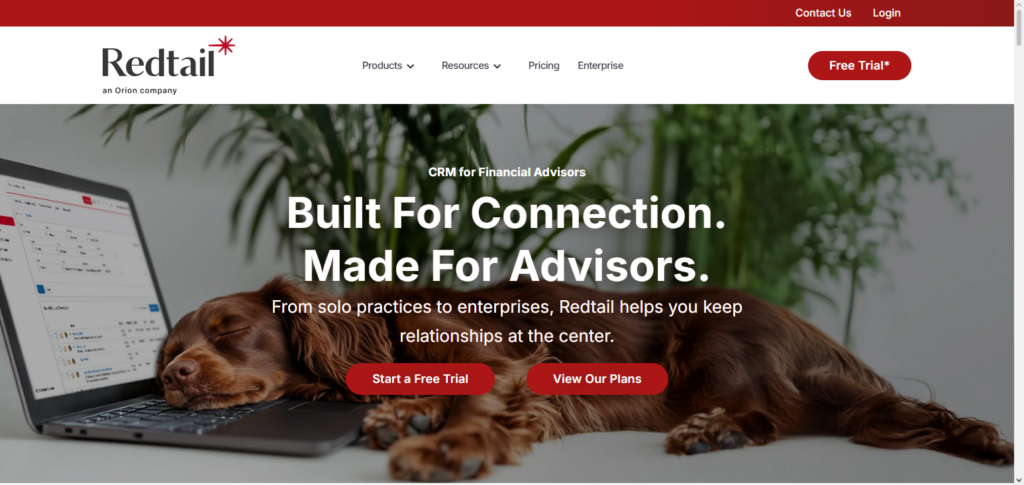
Redtail supports advisory practices of any size and simplifies the management of client communications by means of built-in compliance tools, texting, email correspondence, and compliance archiving.
Redtail is ideal for advisors that are looking to connect with the financial planning CRM ecosystem and would like to automate advisory workflow to the fullest, regardless of the traditional feel of the CRM interface.
CRM Redtail Features:
- Contact Management – Redtail features facilitate the design of user-friendly client portfolio summaries.
- Task Workflow Automation – Specific financial service provider workflow activities and reminders automatically get.
- Tracking Communication – Financial service providers automatically sync and log calls.
- Dashboards for Activities & Calendars – Visual summaries of activity and client financial service provider task calendars.
- Tools for Advisor Integration – Redtail features connect and integrate with banking tools.
Redtail CRM
| Pros | Cons |
|---|---|
| Easy to use with advisor‑friendly interface | Limited advanced automation |
| Affordable pricing for small firms | Basic reporting compared to competitors |
| Strong contact and workflow management | User interface feels dated |
| Built specifically for financial advisors | Integrations can be limited |
| Great support and training resources | Mobile app isn’t robust |
2. Wealthbox CRM
Wealthbox CRM specializes in customer satisfaction with its focus on simplicity, design, and maintainability. Once properly configured by an administrator, Wealthbox allows financial advisors to seamlessly integrate with office workflow applications for an uninterrupted experience.
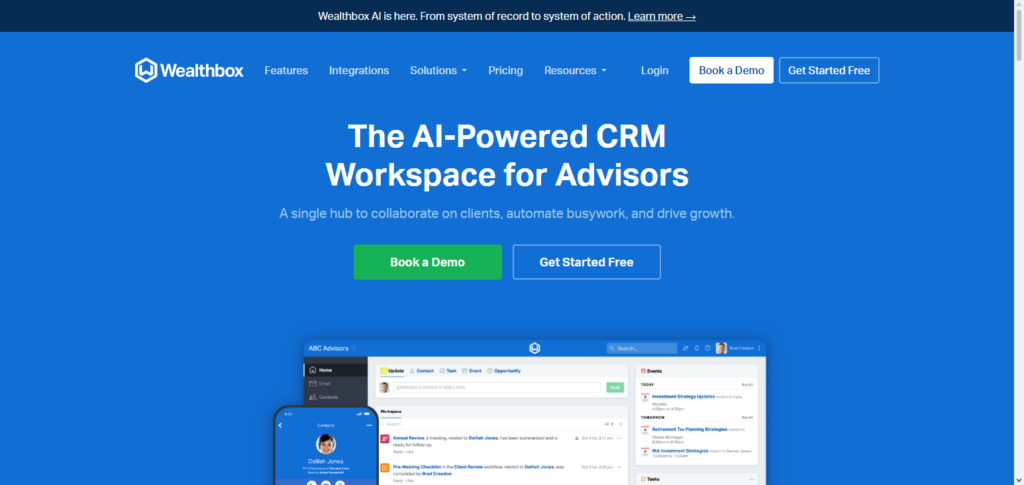
Additionally, Wealthbox provides the ability to manage custom fields, leads, and sales opportunities as well as track and manage office calendars, individual tasks, and email communications, all in one place.
Its activity stream allows advisory teams to easily collaborate. Wealthbox delivers positive experiences for advisors seeking a scalable, advisor-centric CRM solution due to its extensive integrations with custodial platforms and financial planning systems, which support seamless data flow.
Features of CRM Wealthbox:
- Modern & Clean Interface – The interface is self-explanatory and it minimizes the need for training.
- Deal & Pipeline Management – A visual representation of the sales process is available.
- Notes & Activity Stream – A visual timeline for each client is available for active user interaction.
- Automation of Task & Reminder – A financial service provider staying on task is ensured.
- Integration & Sync of Email – There is bi-directional syncing for emails with multiple platforms.
Wealthbox CRM
| Pros | Cons |
|---|---|
| Simple, intuitive user experience | Fewer built‑in financial tools |
| Clean visual activity timelines | Scaling for large enterprises can be tricky |
| Good collaboration and task tracking | Limited deep analytics |
| Easy to set up and maintain | Email integration lag |
| Affordable for small to midsize firms | Customization is moderate |
3. Salesforce Financial Services
Best Financial CRM Software for Advisors Salesforce Financial Services Cloud enables the sophistication and customizability of Salesforce to be utilized in wealth management and financial advisory.
It’s designed for larger and scaling firms with a high degree of flexibility and customization, tailored vertical data models, and AI-powered analytics through Einstein. Advisors can create custom processes, comprehensive client profiles, and automate various functions across sales, customer service, and compliance.
Salesforce is also recognized for its ability to integrate various tools across the client journey, spanning financial planning and marketing. For advisors with substantial requirements, it provides robust CRM functionality with its expansive custom tools and integrations.
Salesforce Financial Services Cloud Features
- Specialized Data Model for the Industry – Customized for the financial sector with household-level and client hierarchies.
- Analytics of Einsten AI – Predictive analytics and analytics on pattern trends.
- Workflows & Automation Customizable – High process configurability.
- Enterprise Reporting and Dashboards – Performing analytics and team metrics.
- AppExchange Ecosystem – Integrate with thousands of external add-ons.
Salesforce Financial Services Cloud
| Pros | Cons |
|---|---|
| Extremely powerful and customizable | Can be expensive |
| Best‑in‑class reporting and analytics | Setup complexity for non‑technical users |
| Massive ecosystem of integrations | Long deployment time |
| Scales with enterprise needs | Requires specialized admin support |
| Strong compliance/security controls | Training curve is steep |
4. Practifi
Best Financial CRM Software for Advisors Practifi emphasizes operational management for advisory firms and intertwines CRM with the management of business processes and project workflows. Practifi brings advisors a uniform work environment to create processes, manage client interactions, and streamline the evaluation of the firm’s operational outputs.
The design enables personalized service models and automation of recurring processes like onboarding and reviews. Practifi also provides real time dashboards and metrics so firms can prioritize and hold teams accountable. While Practifi is less utilized than some competitors, its approach to relationship management combined with operational visibility firm-wide is how firms scale efficiently.
Practifi Features
- Operational Work Management – Designed for process-driven advisory firms.
- Client Lifecycle Tracking – Covers onboarding and milestone services.
- Customizable Engagement Models – Flexible service delivery framework.
- Dashboards and KPI Monitoring – Firm performance metrics.
- Task and Project Automation – Automates advisory tasks.
Practifi
| Pros | Cons |
|---|---|
| Built for financial advisory workflows | Higher price point for advanced tiers |
| Outstanding task and client plan automation | Learning curve for new users |
| Excellent KPI dashboards | Not ideal for very small practices |
| Deep integration with portfolio systems | Customization can be complex |
| Client‑centric design | Support responsiveness varies |
5. Ugraplan CRM
Ugraplan CRM is an award winner as the best financial CRM software for advisors. It is specifically designed for wealth management and advisory teams. The software integrates CRM functions with financial advisory planning, making it very valuable.
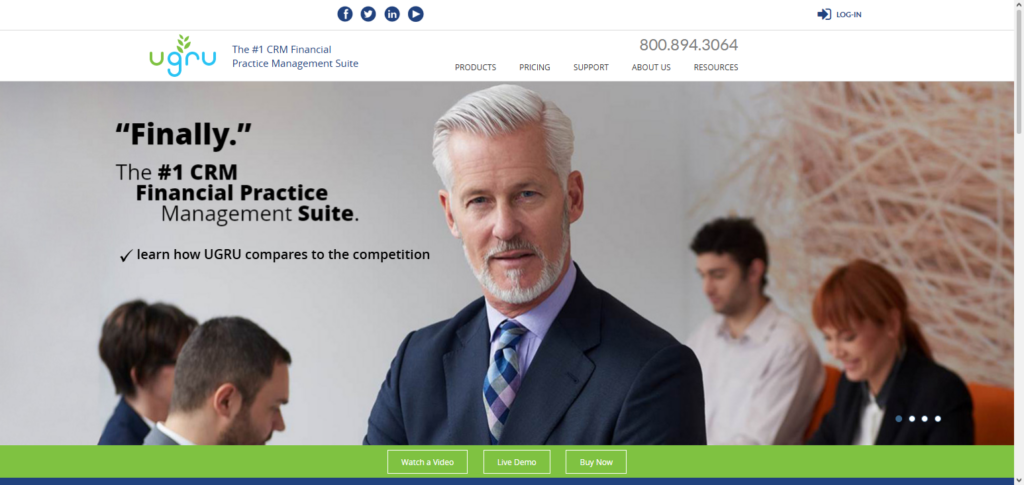
Ugraplan combines relationship data and data pertaining to the client’s portfolio. This integration allows an advisor to see the client’s holdings, goals, risk profile and interactions in one consolidated view. It is also designed for task automation and provides comprehensive reporting for regulatory compliance. This ensures that service delivery is consistent.
The reporting functions also empower advisors to gain valuable insight and drill down into the details for client supply and demand, tailored dashboards that support retention and growth goals, and much more. The range of services offered makes Ugraplan an attractive CRM solution for financial advisors that want an advisory platform that integrates client interaction and financial data.
Ugraplan CRM Features
- Wealth Data Integrated with CRM – Wealth data and CRM hybrid.
- Reporting Tools – Reporting through segmentation and analytics.
- Process Automation – Automation of repetitive tasks.
- Compliance Support – Interaction tracking and audit trails.
- Client Segmentation – Behavioral and financial segmentation.
UgraPlan CRM
| Pros | Cons |
|---|---|
| Designed specifically for financial planners | Smaller user community |
| Clear client planning tools | Fewer third‑party integrations |
| Good task and workflow visibility | Basic reporting features |
| Intuitive layout for advisors | Limited mobile capabilities |
| Affordable pricing | Lesser known brand globally |
6. AdvisorEngine CRM
Best Financial CRM Software for Advisors AdvisorEngine CRM allows advisors to do digital onboarding, client portals and integrated investment tracking. Advisors can manage client records, capture goals, upload important documents, and maintain histories of interactions.
AdvisorEngine is great for onboarding and improving client interactions as it provides advisors one place to manage portfolios and communications. They also help advisors monitor client work and customize what clients see. AdvisorEngine has a lot of integrations and uses them in a smart way to help advisors manage data to improve how they service their clients and their clients’ satisfaction.
AdvisorEngine CRM Features
- Onboarding – Digital onboarding.
- Client Portal – Access to accounts and documents via secure client portal.
- Portfolio Integration – Integrated accounts and investments tracking.
- Cloud Storage – Document management in the cloud.
- Mobile – Access for advisors and clients to be mobile.
AdvisorEngine CRM
| Pros | Cons |
|---|---|
| Modern interface with strong dashboards | Costs can add up |
| Integrated financial planning tools | Best features need higher tiers |
| Combines CRM with portfolio tools | Implementation time is medium |
| Excellent client portal experience | Support can be slow |
| Good reporting and analytics | Limited offline capability |
7. Zoho CRM (Finance Edition)
Best Financial CRM Software for Advisors Zoho CRM (Finance Edition) is a more economical option for advisors with a customizable CRM solution designed to fit the financial services industry.
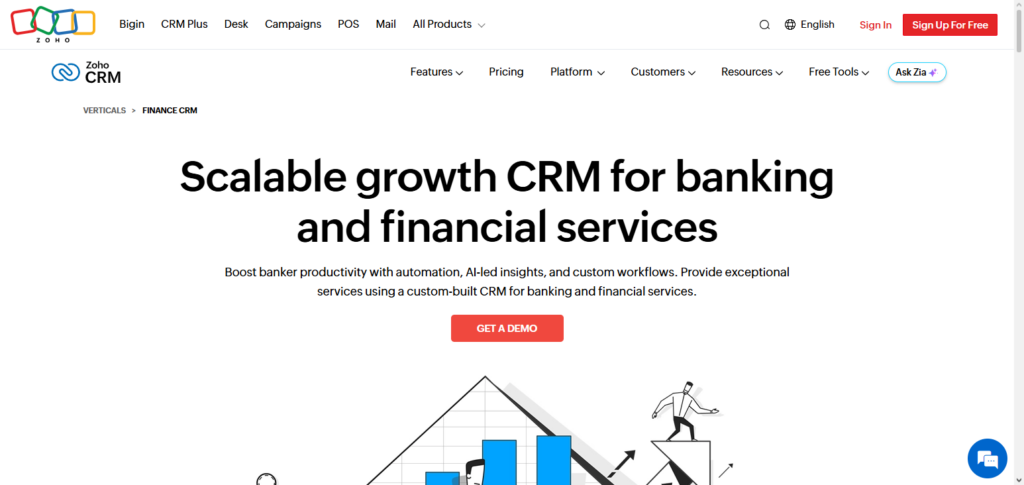
Zoho’s finance edition has specific features for the industry, as well as workflow automation, sales and service insights with AI, and communication tracking (email, phone, and chat). Advisors can customize their dashboards, track the client lifecycle, and access analytics and helpdesk tools. Its pricing is appealing, especially for independent advisors and small firms.
The client segmentation and pipeline forecasting functions in Zoho make it a particularly effective CRM for advisors looking to optimize performance and demonstrate value.
Zoho CRM (Finance Edition) Features
- AI Sales & Insights (Zia) – Identifies upcoming trends and recommends actions.
- Customizable Dashboards – Personalize how you see specific metrics and data.
- Multi‑Channel Engagement – Monitors engagement via email, chat, phone, and social.
- Workflow & Process Automation – Performs repetitive advisor tasks automatically.
- Integration with Zoho Suite – Links with Zoho’s analytics, helpdesk, and finance applications.
Zoho CRM (Finance Edition)
| Pros | Cons |
|---|---|
| Highly customizable platform | Setup complexity |
| Affordable with scalable plans | Advanced features may need add‑ons |
| Strong automation capabilities | User interface can feel crowded |
| Wide integration ecosystem | Finance edition still maturing |
| Excellent mobile app | Learning curve for deep customization |
8. HubSpot CRM (Finance Focus)
Best Financial CRM Software for Advisors HubSpot CRM (Finance Focus) adds to the HubSpot CRM offerings with useful enhancements for financial advisory workflows.
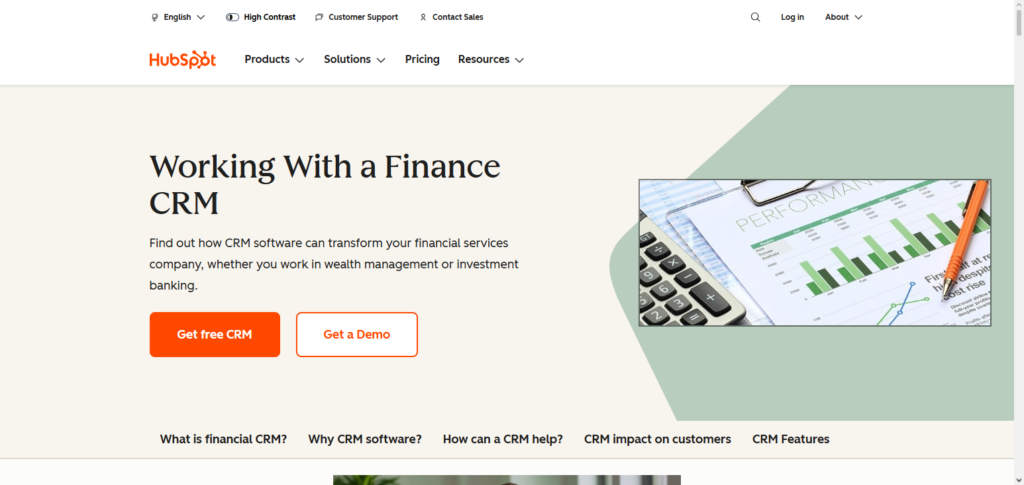
HubSpot is recognized for its user-friendly interface which enables advisors to organize client interactions, oversee lead management, and automate relationship nurturing through pre-set workflows and client interaction timelines.
HubSpot is not solely a CRM for the finance industry, but it provides a useful ecosystem with integrated customer service and marketing hubs for financial advisors to offer streamlined internal workflows and optimized external client engagement.
HubSpot CRM (Finance Focus) Features
- Unified Contact Timeline – See all interactions in one place.
- Engagement Tools – Use email templates, sequences, and engagement tracking.
- Automated Workflows – Helps to manage and nurture your prospects and clients.
- Reporting & Dashboards – Track performance with visually clear reports.
- Marketing & Sales Integration – Integrates CRM with marketing and sales growth tools.
HubSpot CRM (Finance Focus)
| Pros | Cons |
|---|---|
| Intuitive and easy to adopt | Advanced features require premium plans |
| Great marketing and sales tools | Costs increase quickly |
| Excellent email & pipeline tracking | Not built specifically for finance natively |
| Free tier available | Limited built‑in financial planning |
| Strong ecosystem with marketplace apps | Analytics can be basic |
9. Xplan (IRESS)
Best Financial CRM Software for Advisors Xplan (IRESS) adapts CRM functionality for advanced wealth management and portfolio administration. Xplan’s comprehensive solution centralizes client data, transaction histories, financial plans, and reports.
It supports advisory teams’ compliance and planning needs. Its analytics and document management equips advisors to personalize services based on advanced financial insights. Integrated market data and custodial platforms enable effortless operational workflows.
The greatest benefit of Xplan is the ability to combine strong CRM basics with wealth management features, making it perfect for companies that need both relationship management and portfolio management.
Xplan (IRESS) Features
- Portfolio & Wealth Management – Comprehensive financial and planning tools.
- Market Data Integration – Pricing and analytics in real time.
- Client Reporting & Statements – Financial reports customized to your specification.
- Compliance & Audit Trails – Monitors interactions in certain regulated areas.
- Document & Data Centralization – Maintains all client data in one place.
Xplan (by IRESS)
| Pros | Cons |
|---|---|
| Designed for wealth management workflows | Expensive for smaller firms |
| Deep compliance and reporting tools | Complex setup |
| Excellent portfolio management | Training required |
| Trusted in financial services industry | Customization requires specialists |
| Powerful data consolidation | Less user friendly for new users |
10. SmartOffice CRM (Ebix)
Best Financial CRM Software for Advisors SmartOffice CRM (Ebix), is an advisor-centric CRM from Ebix focusing on client lifecycle management and client compliance assistance.
SmartOffice CRM centralizes client information, interactions, tasks, and document storage to help advisors stay organized and maintain relationship records. SmartOffice integrates email, calendar, and allows advisors to create custom workflows to mimic their firm’s operational structure.
SmartOffice integrates with financial planning and portfolio management systems so advisors can track client performance and their engagement. Although it likely lacks the modern look of many newer CRMs, SmartOffice is comprehensive enough to meet all operational and technical needs of established advisory firms.
SmartOffice CRM (Ebix) Features
- Client Lifecycle Tools – Comprehensive tracking for each stage of the advisory relationship.
- Email & Calendar Integration – Communication tools merged in one place.
- Task & Workflow Management – Organized automation of advisor tasks.
- Compliance Documentation – Secured storage and documentation.
- Integration with Financial Systems – Integrates with planning and portfolio management tools.
SmartOffice CRM (Ebix)
| Pros | Cons |
|---|---|
| Built for financial professionals | Interface can feel outdated |
| Strong client data capture | Customization is limited |
| Good task and schedule management | Support quality varies |
| Solid integration with Ebix products | Reporting could improve |
| Workflow automation | Mobile experience is weak |
Conclusion
Financial advisors looking to improve interactions with clients, simplify processes, and grow their practice in 2026 must choose appropriate financial CRM systems. When it comes to client management, task automation, and compliance, Redtail CRM, Wealthbox CRM, and Salesforce Financial Services Cloud are known to provide effective, customized services.
Newer competitors with portfolio management and operational management like Practifi, AdvisorEngine, and Xplan (IRESS) are also available. Your firm’s size and future goals shape preference in technologies to assist in CRM selection. CRM systems increase advisors’ ability to create customized client services and build efficient, sustainable businesses.
FAQ
What is financial CRM software and why do advisors need it?
Financial CRM (Customer Relationship Management) software helps advisors organize client data, track interactions, automate workflows, manage compliance, and improve client service. It’s essential for building stronger relationships, increasing productivity, and scaling advisory practices.
How does a financial CRM differ from a generic CRM?
Financial CRMs are tailored to advisory workflows, compliance requirements, client financial data, and integrations with planning tools. Generic CRMs lack industry‑specific features like portfolio tracking and compliance support.
Which CRM is best for small advisory firms?
Platforms like Redtail CRM, Wealthbox CRM, and Zoho CRM (Finance Edition) are user‑friendly and affordable, making them excellent choices for smaller teams.
Are enterprise CRMs worth the investment?
Yes — solutions like Salesforce Financial Services Cloud provide advanced customization, AI analytics, and scalability, making them ideal for larger firms with complex needs.
Can CRM software improve client retention?
Absolutely. By centralizing client interactions, automating reminders, and tracking client preferences, CRMs help advisors provide personalized service, boosting satisfaction and loyalty.