




In this post, I’ll talk about On-Chain Mapping, a cutting-edge method of employing blockchain technology to create and manage geospatial data.
On-chain mapping guarantees accuracy, transparency, and real-time updates by decentralizing map construction and rewarding contributors with tokens. Decentralized GIS is revolutionizing mapping by making it safe, community-driven, and available to companies globally, as demonstrated by platforms such as Hivemapper.
Understanding On-Chain Mapping
The creation, archiving, and administration of geospatial data on a blockchain is known as “on-chain mapping,” which makes maps visible, decentralized, and impenetrable. With on-chain mapping, contributions from a worldwide network of users are recorded using blockchain technology, in contrast to traditional GIS systems that depend on centralized servers and proprietary data.

Accuracy and accountability are ensured by verifying and permanently storing every map update or data point. Token awards can be used to compensate contributors, promoting real-time updates and crowdsourcing data collecting.
This method allows for open access to geospatial data, improves security, and stops data manipulation. Autonomous vehicles, urban planning, logistics, and other sectors needing accurate, decentralized, and current geographic data may find on-chain mapping especially useful.
Hivemapper Overview
Hivemapper is a decentralized mapping network that creates an open, worldwide map by utilizing crowdsourced contributions and blockchain technologies. Hivemapper enables people and organizations to use dashcams and other devices to take and upload geospatial imagery, eliminating the need for centralized data sources.
Depending on the worth and originality of the data they contribute, contributors are rewarded with the network’s native coin. In order to guarantee transparency, immutability, and community governance, the platform keeps track of map data on-chain.
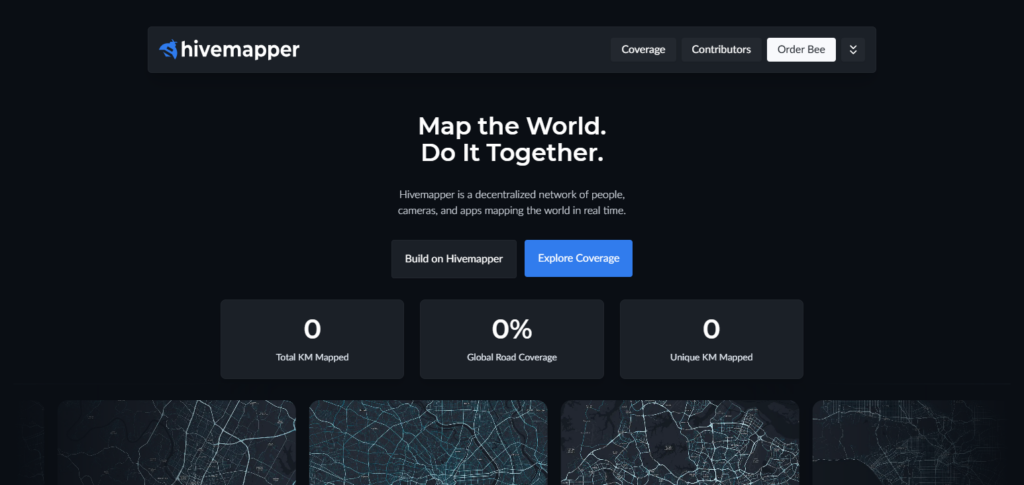
Over time, the map becomes more accurate and up-to-date due to the constant updates and high-resolution coverage that this incentivized approach promotes.
The decentralized methodology of Hivemapper seeks to democratize map production, lessen reliance on conventional suppliers, and open up new applications in location-based apps, logistics, and autonomous systems.
Advantages On-Chain Mapping
Decentralization
Maps are more resilient and censorship resistant since they are not reliant on one single hurting entity.
Transparency
Anyone can verify a record on the blockchain to check if data is authentic.
Incentivized Participation
The more users provide reliable geospatial data, the more they get paid, and this motivates users to participate.
Immutability
Data recorded on the map is permanently reliable and trustworthy.
Up-to-date Maps
Faster than older systems of GIS, maps reflect current changes due to the contributions of corrective data.
Free Maps
Anyone can access the maps creating more innovation and cooperative design.
Hack Resistant
The maps can’t be paid off like other systems.
Factors Behind Hivemapper’s Success
Crowdsourced Data Model
Relies on a global network of contributors to provide coverage of new and existing maps.
Token Based Incentivization Model
Contributors receive cryptocurrency for their recommendations, which encourages the submission of relevant and accurate data.
Integrity of Data via Blockchain Technology
Each update to a map is recorded on-chain, fostering trust and transparency in the underlying data.
Mapping Technology
Dash cams, drones, and artificial intelligence are used to collect and map geospatial data.
Community Building
Hivemapper engages the community to identify, verify, and sustain their network.
Partnerships and Integrations
Hivemapper has partnered with several businesses and autonomous systems, increasing the number of possible applications.
Scalable & Flexible
Hivemapper has the ability to keep growing, and focuses on on providing useable data to businesses, spanning from logistics to urban development.
Challenges and Limitations
Scalability Issues
There are still many regions to cover, and we will still need a sizable number of contributors and the right infrastructure to take care of the coverage gaps.
Data Privacy Issues
The use of crowdsourced images raises an issue of images of individuals being captured and regulations in those regions of the world.
Dependence on Contributors
The quality of the map is mostly reliant on the users, and the parameters and values that they take time to submit.
Competition with Legacy GIS
Google Maps and other established mapping services have greater resources and dominance in the market.
Regulatory Concerns
The use of blockchain in mapping will cause legal and regulatory issues in various jurisdictions.
Technical Issues
The use of mapping, tokenomics, and blockchain in multiple domains may overwhelm users.
Decentralized GIS
The system relies on the continuous validation of data and the stability of the blockchain.
The Future of Decentralized GIS

Decentralized GIS (Geographic Information Systems) has the potential to revolutionize the production, exchange, and use of geospatial data in the future.
Decentralized GIS eliminates dependency on centralized authorities by utilizing blockchain technology to guarantee transparency, immutability, and safe access to mapping data. Real-time accuracy improvement and coverage expansion will be sustained by crowdsourced contributions that are rewarded with tokens.
Autonomous vehicles, smart city development, logistics optimization, urban planning, and environmental monitoring are examples of emerging uses. Additionally, decentralized GIS promotes cross-sector collaboration, which stimulates creativity in predictive mapping and data analysis.
As uptake increases, these systems have the potential to upend established GIS marketplaces and increase the democratic, dependable, and accessible nature of geographic information for governments, corporations, and individuals globally.
Pros & Cons
| Pros | Cons |
|---|---|
| Decentralization: No reliance on a single authority, reducing censorship risks. | Scalability Challenges: Expanding global coverage depends on contributor participation. |
| Transparency: All map updates are recorded on-chain for verification. | Data Privacy Concerns: Crowdsourced imagery may raise privacy and regulatory issues. |
| Incentivized Contributions: Users earn tokens for providing accurate data. | Dependence on Contributors: Map quality relies on active and accurate submissions. |
| Immutable Data: Information cannot be tampered with once recorded. | Regulatory Uncertainty: Blockchain-based mapping may face legal challenges in some regions. |
| Real-Time Updates: Crowdsourced data ensures maps remain current. | Technical Complexity: Integrating blockchain, mapping tech, and tokenomics can be challenging. |
| Security: Blockchain protects data from hacks and unauthorized changes. | Competition: Traditional GIS providers dominate with more resources and market share. |
Conclusion
Geospatial data creation, verification, and sharing have undergone a radical change thanks to on-chain mapping. By providing precise, real-time maps and compensating users, platforms such as Hivemapper showcase the strength of decentralization, crowdsourcing contributions, and blockchain transparency.
The advantages of immutable, secure, and motivated mapping are indisputable, even in the face of obstacles like scalability, privacy issues, and regulatory barriers.
From autonomous cars to urban planning, decentralized GIS has the potential to transform a variety of industries by increasing accessibility, dependability, and community-drivenness of geographic information. Not only is on-chain mapping the way of the future, but it is also a step toward making geographic data accessible to all.
FAQ
What is on-chain mapping?
On-chain mapping is the process of creating, storing, and managing geospatial data on a blockchain, making maps decentralized, transparent, and immutable.
How does Hivemapper use on-chain mapping?
Hivemapper leverages blockchain and crowdsourced contributions, rewarding users with cryptocurrency for uploading geospatial data and ensuring map updates are secure and verifiable.
What are the benefits of on-chain mapping?
Key benefits include decentralization, transparency, immutability, real-time updates, incentivized contributions, enhanced security, and open access to geographic data.
What challenges does on-chain mapping face?
Challenges include scalability, privacy concerns, regulatory issues, dependence on contributors, and competition with traditional GIS providers.
What is the future of decentralized GIS?
Decentralized GIS is expected to drive innovation in autonomous vehicles, logistics, urban planning, and environmental monitoring, democratizing geospatial data globally.