

In this article, I will analyze the Portfolio Optimization Tools for Smart Investors that assist in maximizing returns and minimizing risks. These tools feature advanced analytics, performance tracking, and scenario simulations across different asset classes.
- What is Portfolio Optimization Tools?
- Why Best Portfolio Optimization Tools for Smart Investors
- Key Point & Best Portfolio Optimization Tools for Smart Investors
- 1. Morningstar Direct
- Morningstar Direct Features, Pros & Cons
- 2. FactSet Portfolio Analytics
- FactSet Portfolio Analytics Features, Pros & Cons
- 3. Refinitiv Eikon (LSEG)
- Refinitiv Eikon (LSEG) Features, Pros & Cons
- 4. Portfolio Visualizer
- Portfolio Visualizer Features, Pros & Cons
- 5. QuantConnect Designer
- QuantConnect Designer Features, Pros & Cons
- 6. RiskMetrics (MSCI)
- RiskMetrics (MSCI) Features, Pros & Cons
- 7. PitchBook Institutional
- PitchBook Institutional Features, Pros & Cons
- 8. Securitize Markets
- Securitize Markets Features, Pros & Cons
- 9. ADDX
- ADDX Features, Pros & Cons
- 10. Cambridge Associates Portfolio Tools
- Cambridge Associates Portfolio Tools Features, Pros & Cons
- Conclusion
- FAQ
They help investors make data-driven and informed decisions, and efficiently optimize their portfolios in the dynamically changing financial markets today, from conventional equities and bonds to alternative and even digital investments.
What is Portfolio Optimization Tools?
Portfolio optimization tools are programs that allow investors, managers, and institutions to design and optimize investment portfolios to achieve maximum efficiency.
These tools use cutting-edge analytics, historical data, risk modeling, and simulation to determine how to best optimize, structure, and manage portfolios across equities, bonds, ETFs, alternatives, and digital assets.
Researching correlations, volatility, and expected returns helps these tools reduce risk and increase returns. In addition, these tools are critical to developing data-based, informed, and balanced portfolios that are high performaning in today’s complicated financial markets.
These tools often come with features for tracking performance, benchmarking, and reporting to add further value.
Why Best Portfolio Optimization Tools for Smart Investors
Maximize Risk-Adjusted Returns – Best Portfolio Optimization Tools give investors the means to manage and spread their assets in such a manner to give a predicted higher return regardless of predetermined risk measures. This applies to the Sharpe Ratio and Value-at-Risk (VaR) analytics.
Data-Driven Decision Making – These tools give investors the ability to use market data from the past and present (real time) and predictive analytics for market forecasts to assist in making objective decision for smart investments.
Advanced Risk Management – Tools such as RiskMetrics and FactSet provide the ability to conduct scenario analyses, stochastic simulations, and the monitoring of market correlations for the purpose of risk exposure to market volatility.
Portfolio Diversification – Best Portfolio Optimization Tools analyze the various correlations of assets in order to ensure diversification of investments in stocks, bonds, alternatives, and even digital assets.
Time and Efficiency Savings – Reporting dashboards, automated processes, and optimization algorithms means less time on manual processes and gives investors the ability to adjust their portfolio quickly to focus on high impact strategies.
Support for Multiple Asset Classes – Morningstar Direct, ADDX and PitchBook are instrumental in providing the tools to manage a digital, private, or traditional asset in a consolidated view in a platform.
Performance Monitoring and Benchmarking – Investors have the ability to make changes to a portfolio to improve performance of the portfolio by comparing the portfolio to a benchmark or standard to assess the performance of similar investments in the market.
Enhanced Strategy Testing – Investors have the ability to test market strategies (real or hypothetical) using back-testing and market simulations before investing real money.
Access to Institutional-Grade Insights – Tools such as Cambridge Associates and Refinitiv Eikon provide the same insights given to competitive convenience professionals to market their portfolios to give smart investors a lower hedge.
Future-Proofing Portfolios – AI and predictive analytics help determine upcoming market tendencies, find potential opportunities, and make changes to portfolios so that they’re set for success in the long run.
Key Point & Best Portfolio Optimization Tools for Smart Investors
| Tool Name | Key Points / Features |
|---|---|
| Morningstar Direct | Comprehensive fund, equity, and ETF data; risk-return modeling; scenario analysis; multi-asset portfolio tracking; performance benchmarking. |
| FactSet Portfolio Analytics | Multi-asset performance attribution; stress testing; real-time data integration; advanced risk modeling; customizable reports and dashboards. |
| Refinitiv Eikon (LSEG) | Real-time market data and news; portfolio tracking; asset correlation analysis; AI-driven insights; customizable dashboards. |
| Portfolio Visualizer | Backtesting and Monte Carlo simulations; asset correlation analysis; multi-asset allocation modeling; risk-adjusted metrics; scenario and factor analysis. |
| QuantConnect Designer | No-code algorithmic strategy building; backtesting across multiple assets; real-time market integration; machine learning support; automated execution. |
| RiskMetrics (MSCI) | Portfolio risk assessment and VaR; factor exposure analysis; stress testing; historical volatility tracking; customizable reporting dashboards. |
| PitchBook Institutional | Private market data analytics; portfolio tracking for PE/VC; benchmarking and performance analysis; liquidity and cash flow modeling; deal sourcing insights. |
| Securitize Markets | Digital asset and tokenized investments; portfolio tracking and risk assessment; allocation modeling; blockchain data integration; compliance and transparency reporting. |
| ADDX | Digital securities and alternative assets; portfolio allocation optimization; scenario modeling for liquidity/returns; automated reporting; private equity and real estate support. |
| Cambridge Associates Portfolio Tools | Multi-asset portfolio analysis; scenario modeling and stress testing; risk-adjusted return tracking; benchmarking against global indices; customizable reporting dashboards. |
1. Morningstar Direct
Morningstar Direct is an investment analysis tool used by institutional investors. It offers extensive data on mutual funds, ETFs, stocks and other alternative assets. It allows investors to model risk and return accurately as well as analyze scenarios, model the impact of different factors and benchmark performance.
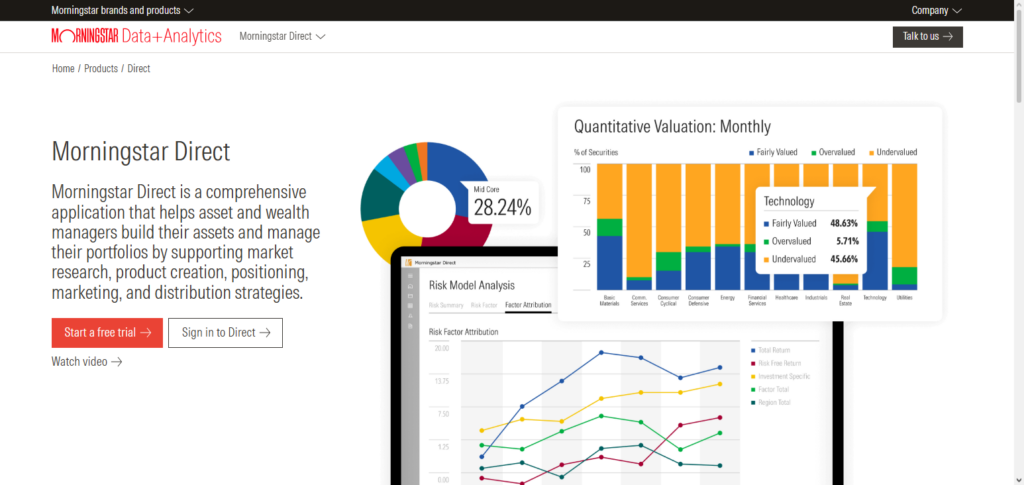
Portfolio managers are kept up to date with real time data on how allocations can be impacted by changes in the market so that when it is time for them to make decisions and/or rebalance their portfolios, they can do so with confidence.
The platform is easy to use and provides the tool that most portfolio managers, as well as other senior investment managers. This is why it is one of the most technologically advanced portfolio optimization tools for smart investors.
Morningstar Direct Features, Pros & Cons
Features:
- Fund, equity, and ETF information.
- Aspects of modeling and risk-return analysis.
- Benchmarking your portfolio performance.
- Tracks allocation and analysis in multi-asset classes.
- Excellent tools and dashboards for reporting.
Pros:
- Great for the analytics needed for institutional investors.
- Great for monitoring portfolios.
- Excellent and accurate real-time/historical information.
- Reporting and data visualization is customizable.
- Optimizing portfolios for multi-assets is available.
Cons:
- Has a high cost for small-scale investors.
- Support for crypto/digital assets is limited.
- May be complex for novices.
- Requires a reliable, high-speed internet connection.
- Requires advanced training for some complex features
2. FactSet Portfolio Analytics
FactSet Portfolio Analytics is one of the top portfolio optimization and risk management applications in the marketplace. Investors have access to multi-asset class performance attribution, stress testing, and scenario analysis.
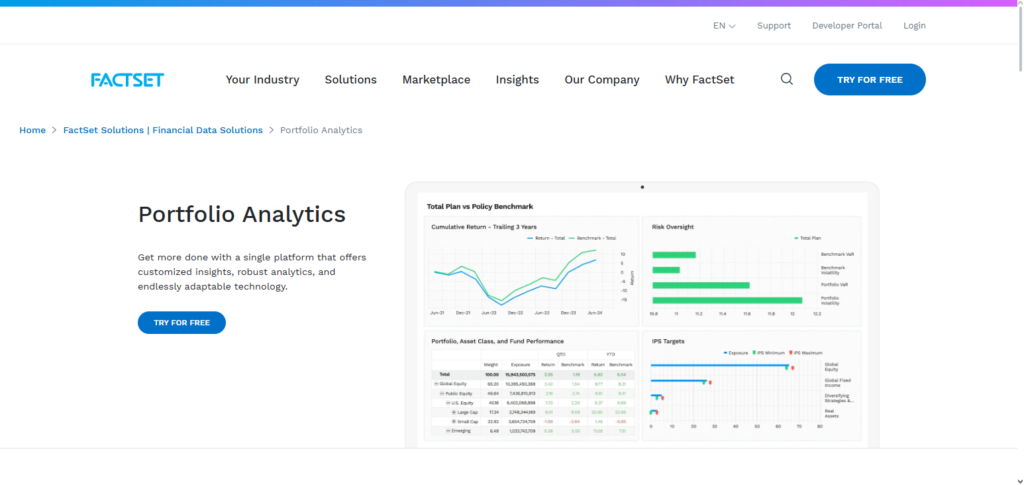
FactSet integrates real time market data with the history of the marketplace in order to provide actionable insights to portfolio managers that highlight areas of inefficiency as well as the appropriate allocation for optimization in order to achieve the best investment performance.
The ability to analyze and calculate the risk associated with alternative class assets and derivatives is what makes FactSet Portfolio Analytics one of the best portfolio optimization tools for the smart investors.
FactSet Portfolio Analytics Features, Pros & Cons
Features:
- Integration of performance attribution for multiple assets.
- Stress and scenario based simulation.
- Market data in real-time.
- Excellent tools for advanced modeling of risk.
- Reporting and visualization is customizable.
Pros:
- Excellent analytics for institutional portfolios.
- Excellent risk assessment, factor analysis, and support for alternatives.
- Excellent and high-quality support to clients.
- Integrates with Excel and with APIs.
Cons:
- High cost for subscriptions.
- Default settings are frustrating for novices.
- Requires additional modules for some features.
- Some features make the interface feel cluttered.
- Free trial options your available tests are severely limited.
3. Refinitiv Eikon (LSEG)
Refinitiv Eikon, offered by LSEG, is one of the best financial data platforms for the management and optimization of portfolios. Using Eikon, investors have access to data, analytics, and research related to financial markets, enabling them to understand and measure risk, evaluate relationships between different financial instruments, and forecast different portfolio scenarios.
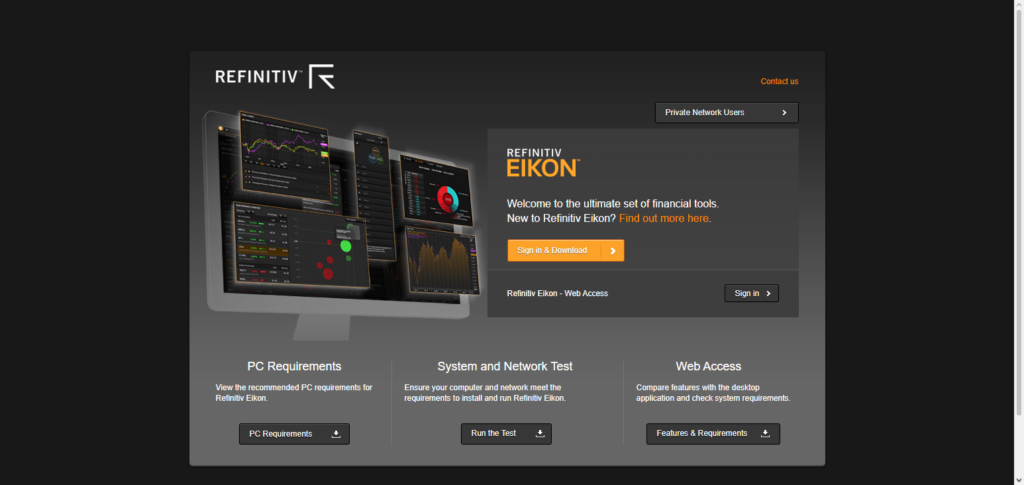
With Eikon, the user is able to trade, manage positions, understand the behavior of the financial markets, and modify their financial strategy. Eikon allows users to customize how they want to visualize data related to their portfolio’s different allocations, performance, and risk exposures.
Eikon uses proprietary AI to develop portfolio management analytical tools to enable users to manage portfolios from a risk perspective. For these reasons, investors around the world view Refinitiv Eikon as one of the best tools for portfolio optimization.
Refinitiv Eikon (LSEG) Features, Pros & Cons
Features:
- Instant access to news and data about the market.
- Portfolio management and performance analysis.
- Risk modeling and asset correlation.
- Decision-making driven by AI.
- Different features and reporting.
Pros:
- Coverage and updates about the global market.
- Helpful analytical and visualization features.
- Multiple data feeds integrations.
- Equities, bonds and alternatives supported.
- Scenario and risk analysis tools.
Cons:
- High subscription costs.
- To use the software properly, training is required.
- The interface is complicated to new users.
- Many features are paid.
- High data and software usage by the system.
4. Portfolio Visualizer
Portfolio Visualizer is an online, user friendly, portfolio analysis and optimization tool. Portfolio Visualizer has the capacity to perform strategy backtesting, Monte Carlo simulations, and analysis of risk and return for different portfolios as well as for individual constituents.
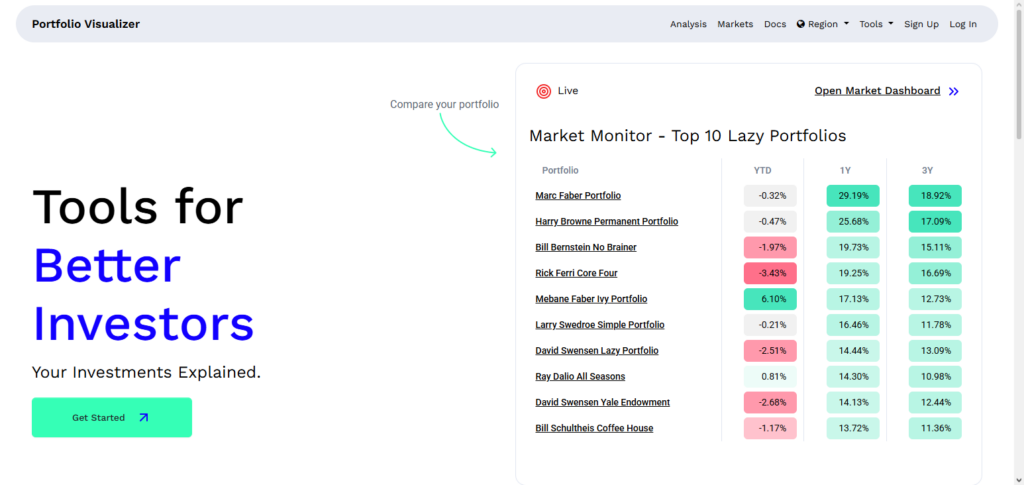
Portfolio Visualizer allows users to analyze historical performance of multi-asset portfolios, assess various portfolios based on the Sharpe ratio or similar metrics (or none) to evaluate risk, and determine the premium earned.
Portfolio Visualizer advanced features such as scenario and factor analyses and portfolio adjustments facilitate user exploration and analyses of potential market changes. For its analytical depth, Portfolio Visualizer is among the best portfolio optimization tools for smart investors.
Portfolio Visualizer Features, Pros & Cons
Features:
- Backtesting and Monte Carlo simulations.
- Analysis of correlations between assets.
- Modeling of multiple asset allocations.
- Metrics on performance adjusted for risk.
- Analysis of scenarios and factors.
Pros:
- Platform is web-based and easy to use.
- Ideal for investors, whether retail or institutional.
- Excellent tools for testing and back-testing.
- Basic features are free to access.
- Portfolio efficiency is revealed quickly.
Cons:
- Coverage of alternative assets is limited.
- Subscription is required for some advanced tools.
- Market data is less available in real time.
- Algorithmic trading is not supported.
- Analysis of complex issues is limited by a simplified interface.
5. QuantConnect Designer
QuantConnect Designer is for portfolio optimization with no coding/algorithm required. With QuantConnect Designer, you can build, test, and deploy custom trading algorithms for equities, forex, and crypto.
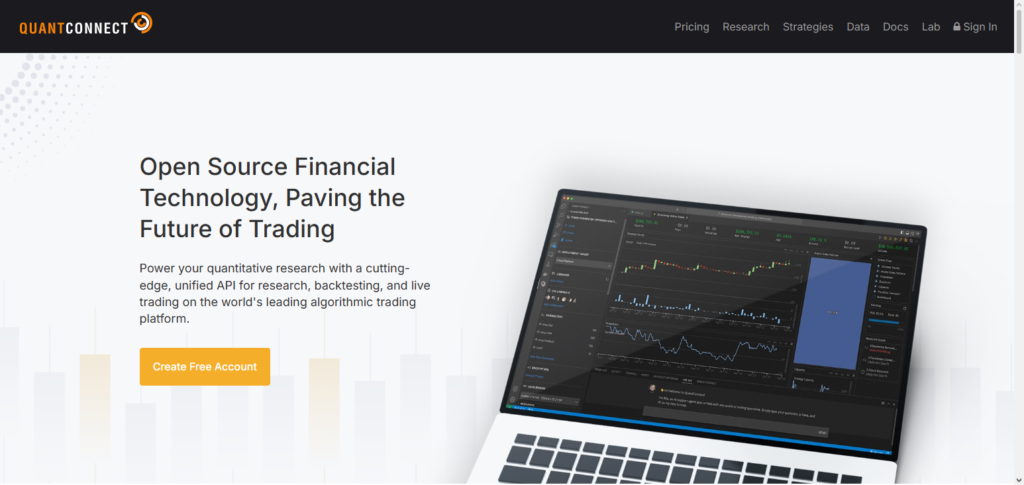
It helps you find the best strategies for portfolios with the best risk-adjusted returns by testing portfolios and simulating historical data. It also provides real-time market data, allowing you to adjust and execute automatically.
The tools incorporated for AI and machine learning improve your predictive models and in turn, your investment returns. All of these components position QuantConnect Designer as a premier portfolio optimization tool for smart investors.
QuantConnect Designer Features, Pros & Cons
Features:
- No-code building of algorithmic strategies.
- Backtesting of multiple asset classes.
- Integration of real-time market data.
- Support for machine learning and AI models.
- Automated strategies execution.
Pros:
- Automation and algorithmic trading are supported.
- Excellent for quantitative investors at an advanced level.
- Flexible for equities, forex, and crypto.
- Excellent tools for backtesting and simulations.
- Library is open-source for customization.
Cons:
- High learning curve for beginners.
- Advanced coding features require coding knowledge.
- Free tier is limited.
- Paid plans offer real-time data.
- Complexity is overwhelming for casual investors.
6. RiskMetrics (MSCI)
RiskMetrics, a part of MSCI, is a leading risk and portfolio optimization tool. It has extensive analytical features on volatility, beta, value-at-risk (VaR), and stress testing scenarios. Portfolio managers can evaluate correlations and carry out risk-reducing hedges.
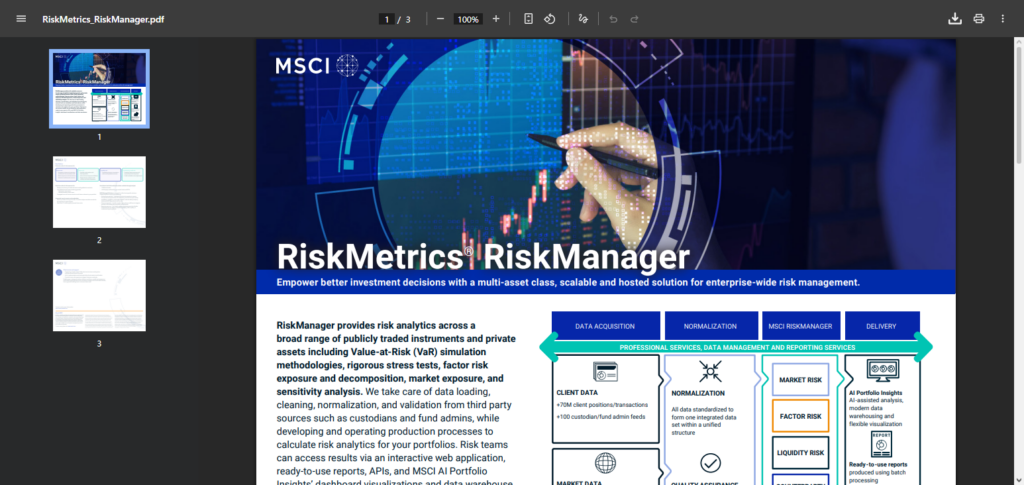
The historical and predictive data of RiskMetrics allows for precise risk modelling in a multitude of market situations.
The advanced risk management and visualization features assist and enhance the decision-making process of equities and fixed-income portfolios. It is for these reasons that RiskMetrics is professed to be among the best portfolio optimization tools for smart investors.
RiskMetrics (MSCI) Features, Pros & Cons
Features:
- Risk and VaR analysis.
- Exposure to factors.
- Multiple scenario stress tests.
- Measures of historical volatility and correlation.
- Reporting dashboards that are customizable.
Pros:
- Risk modeling tools are extremely accurate.
- Multi-asset class portfolio construction.
- Risk management for institutions is a must.
- Provides scenario testing for extreme event markets.
- Industry prevalent and trusted tool.
Cons:
- Costs for individual investors is prohibitive.
- Learning curve is steep for novice users.
- Tools to optimize investments are lacking.
- History > Future mentality.
- Some tools require training.
7. PitchBook Institutional
Private capital market investment analytics like PitchBook Institutional provides detailed data on private equity, venture capital, and Mergers and Acquisitions.
For portfolio optimization, there is performance benchmarking, liquidity planning, scenario analysis, and liquidity. Investors are able to track fund performance, company performance, model cash flows, and optimize fund allocation based on predicted returns and risk exposure.
PitchBook analytics provides insights that help institutional investors identify investments and data-driven insights that increase value and improve portfolio health. PitchBook Institutional is private market intelligence combined with portfolio modeling and provides one of the \best portfolio optimization tools for smart investors\ in alternative assets.
PitchBook Institutional Features, Pros & Cons
Features:
- Analytics for private market.
- PE/VC portfolio management.
- Benchmark and performance analytics.
- Liquidity and cash flow models.
- Insights for deal sourcing and valuations.
Pros:
- Fantastic private and alternative investment offering.
- Comprehensive VC, PE, and M&A deal data.
- Virtual (re) structured scenario portfolio planning and (re) modeling.
- Robust analytics and reporting.
- High returns with detail
Cons:
- Subscription fees are aimed at bigger businesses.
- Doesn’t consider public/mature market investors.
- Analytics for alternative assets have a steep learning curve.
- Insufficient data for active trading.
- Market data is limited.
- Sub-optimal data on the strategies for trading.
8. Securitize Markets
Securitize Markets is a digital asset and tokenized investment platform designed for portfolio optimization for today’s investors. It fosters analysis and management of tokenized securities, equities, and alternative investments.

Investors can track holdings, analyze risk, and run allocation simulations for both traditional and digital assets. Securitize Markets uses real-time blockchain data as the basis for portfolio adjustments and compliance monitoring.
Market volatility exposure is minimized and returns are optimized for investors due to Securitize’s transparency, automation, and liquidity modeling. With these tools, Securitize Markets is positioned as a leader in portfolio optimization for digital and tokenized investment strategies.
Securitize Markets Features, Pros & Cons
Features:
- Investments within the digital and tokenized asset.
- Risk and portfolio analytics.
- Scenarios for modeling allocations for crypto and alt. assets.
- Integrated blockchain and real-time data.
- Transparent compliance and reporting.
Pros:
- Optimized for digital and tokenized assets.
- Platform is transparent and secure.
- Portfolio adjustments are real-time and compliance is secure.
- Tools for automation of allocation and tracking.
- Ecosystem for seamless investment of ai digital and traditional.
Cons:
- Less traditional assets.
- Knowledge of digital assets required.
- User base smaller than traditional systems.
- More complicated regulatory requirements.
- Additional features may be offered only in advanced payment plans.
9. ADDX
ADDX offers proprietary technology for the optimization of investors’ portfolios and management of alternative assets within security tokens. ADDX offers private equity investments, real estate investments, and investments in funds, asssociated with advanced analytics and tools for investment allocation.
Automated scenario modeling, risk management, and performance monitoring tools assist investors in optimizing their portfolios concerning liquidity and profitability. Automated investments reporting and investment valuation transparency assist and automate investments monitoring and investments rebalancing.
ADDX facilitates new portfolio optimization innovations by merging traditional assets and digital assets. ADDX is best portfolio optimization technology for sophisticated investors who seek alternative investment strategies.
ADDX Features, Pros & Cons
Features:
- Digital and alternative assets platform for securities.
- Portfolio allocation modeling and optimization.
- Return and liquidity scenario modeling.
- Reporting and monitoring automation.
- Private equity and real estate investment support.
Pros:
- Investment in alternatives and privates.
- Reporting and valuation transparent.
- Portfolio optimization for liquidity and return.
- New digital assets platform.
- High-net-worth individuals are also offered.
Cons:
- Less support for traditional assets.
- Smaller investment universe.
- Knowledge of digital and private markets required.
- Payment subscriptions are advanced.
- Novices may not find it suited.
10. Cambridge Associates Portfolio Tools
Cambridge Associates Portfolio Tools are designed for institutional and high-net-worth investors that need portfolio optimization at an advanced level. The platform provides analytics, scenario analysis, and stress-testing for multi-asset portfolios.

Investors can analyze their risk-adjusted returns, factor exposures, and allocation inefficiencies. Risk and return trade-off analysis, portfolio monitoring, and personalized reporting are all useful added-value services. With proprietary private and public market data, Cambridge Associates can enhance diversification and optimize returns for complex portfolios under any market scenario.
For its breadth and depth of features, Cambridge Associates Portfolio Tools are among the highest quality portfolio optimization tools for sophisticated investors, especially for those with complex, multi-asset portfolios.
Cambridge Associates Portfolio Tools Features, Pros & Cons
Features:
- Multi-asset portfolio optimization and analysis.
- Stress testing and scenario modeling.
- Return tracking on a risk-adjusted basis.
- Global indices benchmarking.
- Reporting dashboards with a lot of customization.
Pros:
- Great for family offices and institutional investors.
- Public and private market data.
- Analytics for risk control is advanced.
- Multi-asset portfolios supported.
- Good for historically and in the future.
Cons:
- Smaller investors find it expensive.
- Novices find it complicated.
- Minimal real-time data of the markets.
- Professional customization is necessary.
- Institutional users are the main target.
Conclusion
Utilizing advanced tools for portfolio optimization, and considering today’s intricate financial ecosystem, is paramount for astute investors. With their valuable analytical resources, in-depth risk modeling, and robust scenario analysis, appropriate platforms, such as Morningstar Direct, FactSet Portfolio Analytics, Refinitiv Eikon, and Portfolio Visualizer, can support investors in making rational choices.
Furthermore, platforms like QuantConnect Designer, RiskMetrics, and Cambridge Associates Portfolio Tools offer integrated algorithmic methods and stress-testing for risk-adjusted performance that is sophisticated.
Also, for private and digital assets, PitchBook Institutional, Securitize Markets, and ADDX provide both transparency and data-driven methods for allocation. Investors can strategically position themselves in the investment ecosystem and gain competitive advantages with the use of the above tools.
FAQ
What are portfolio optimization tools?
Portfolio optimization tools are software platforms designed to help investors structure and manage their portfolios for maximum returns and minimum risk. They use analytics, historical data, and scenario modeling to optimize asset allocation and balance risk-reward effectively.
Who should use these tools?
These tools are ideal for advanced investors, institutional portfolio managers, family offices, and high-net-worth individuals looking to make data-driven decisions, monitor exposure, and optimize multi-asset portfolios.
Which tools are best for traditional investments?
Morningstar Direct, FactSet Portfolio Analytics, Refinitiv Eikon, and Portfolio Visualizer are highly recommended for equities, bonds, ETFs, and mutual funds.
What about alternative or private market assets?
PitchBook Institutional, Cambridge Associates Portfolio Tools, ADDX, and Securitize Markets specialize in private equity, tokenized assets, and other alternative investments.
Can these tools manage risk effectively?
Yes. Tools like RiskMetrics (MSCI) and QuantConnect Designer provide advanced risk modeling, stress testing, and scenario simulations to mitigate market volatility and optimize portfolios.